The Real Benefits of Vending Machines in Schools
The biggest benefits of vending machines in schools are simple: students get food and drinks when they’re actually hungry, lunch lines get shorter, and the school earns a share of every sale without paying for the machine. When every item meets USDA Smart Snacks and California’s own nutrition rules, a vending machine supports student health instead of working against it.
That’s the short version. The longer one is worth reading, because school vending has changed a lot. The candy-and-soda machine many of us grew up with is gone from California public school hallways. Today’s machines sell water, low-fat milk, nuts, and whole-grain snacks, and they take a phone tap as easily as a dollar bill.
We place and service vending machines for schools, colleges, and workplaces across California. Below is what we tell principals, parents, and food service directors who ask us whether a machine is worth it, including the parts that aren’t a sales pitch.
Should Vending Machines Be Allowed in Schools?
Yes. Vending machines should be allowed in schools as long as every snack and drink inside meets federal and state nutrition standards. That condition matters far more than the machine itself.
Since July 1, 2014, the USDA’s Smart Snacks in School rules have covered almost everything sold to students during the school day outside the meal program, and vending machines are included. California adds its own stricter rules for public schools on top of that. So the real question today isn’t candy machine or no machine. It’s whether students buy a compliant snack on campus or walk to the corner store for whatever they want.
People who support school vending usually point to three things:
- Students get hungry outside of lunch, and plenty of them skip breakfast.
- Schools earn steady money without organizing yet another fundraiser.
- A well-stocked machine makes the healthy choice the easy one.
People who oppose it worry about junk food, distraction, and kids spending money they don’t have. Those are fair concerns, and we answer each one in the pros and cons section further down.
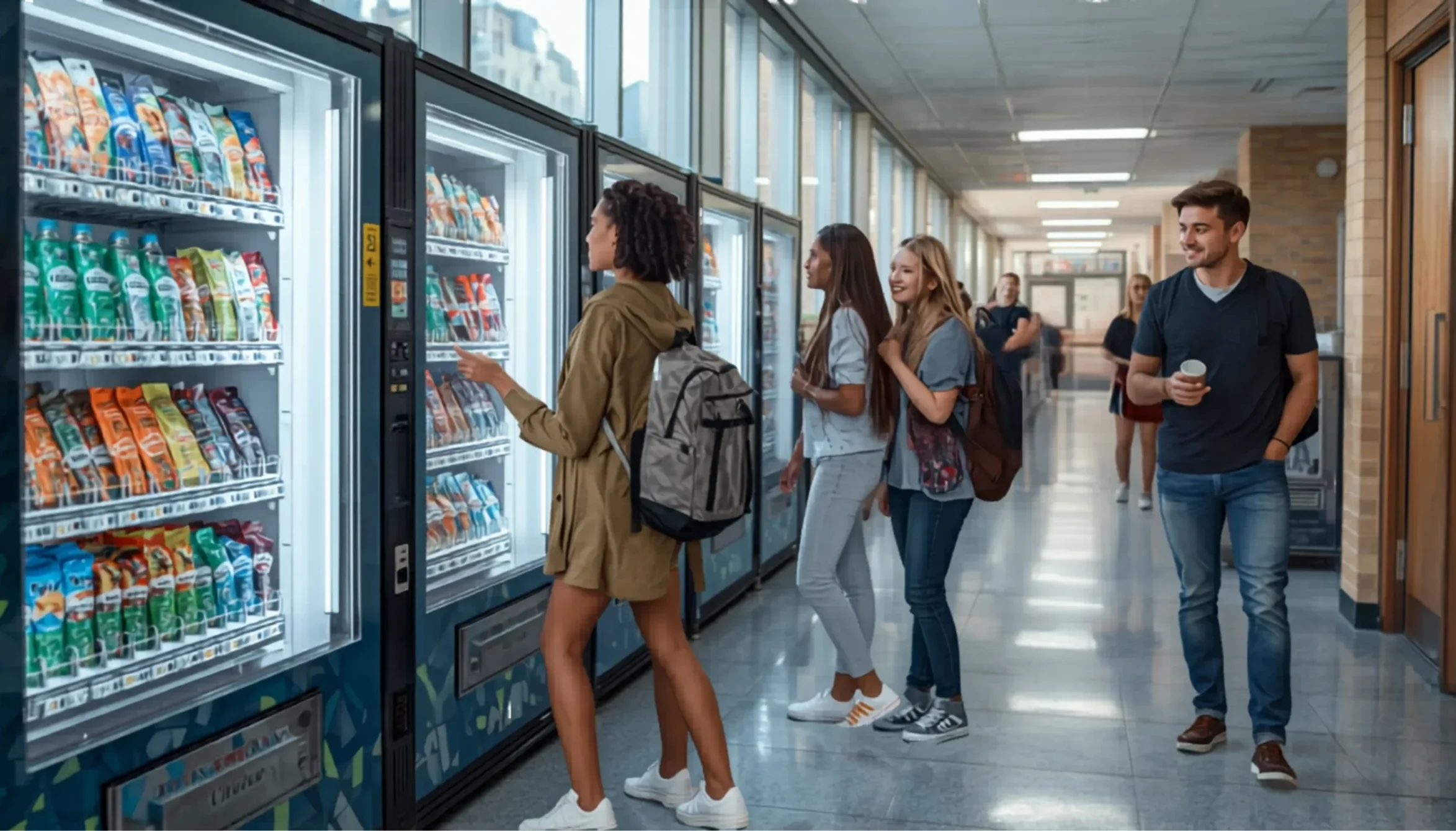
8 Reasons Why Schools Should Have Vending Machines
1. Students can eat when they're actually hungry
Hunger doesn’t follow the bell schedule. A lot of teenagers leave home without breakfast, and the mid-afternoon slump is real. A machine down the hall gives them a compliant snack in under a minute, so they spend fifth period thinking about the lesson instead of their stomach.
2. The healthy option becomes the convenient one
Most of us eat whatever is closest, and students are no different. When the closest option is a bag of almonds or a whole-grain bar, that’s what gets eaten. Healthy vending works because it puts the better choice exactly where the craving happens, without a lecture attached.
3. Money for school programs, without another bake sale
With a full-service operator like us, the school pays nothing for the machine. We install it, stock it, and pay the school a commission on sales. That money can go to athletics, clubs, field trips, or classroom supplies.
How much a school earns depends on enrollment, placement, and pricing, so no honest vendor can promise a number upfront. Ask for the commission rate in writing before you sign anything.
4. Shorter lunch lines
When a short lunch period meets a long line, some students simply give up and skip eating. A machine near the quad, gym, or library spreads that crowd out across campus. It should supplement the cafeteria, never replace it, and food service staff get a little breathing room during the rush.
5. Payment that fits how students actually pay
Many students carry a phone, not cash. Our machines accept cards, Apple Pay, and Google Pay, which makes each sale take seconds and means less cash sitting on campus. We still keep a cash option, though. A student without a bank card shouldn’t be locked out of a snack.
6. Fuel for practice, clubs, and after-school programs
The cafeteria closes in the early afternoon, but practice, rehearsal, and tutoring often run into the evening. A snack machine or drink machine near the gym or library gives students water, milk, and protein snacks before they need them.
State food rules cover the school day plus 30 minutes. Most schools we work with keep the same healthy mix all day anyway, because their wellness policy asks for it.
7. No extra work for school staff
Smart vending machines report their own stock levels, temperature, and errors to us remotely. We restock before items run out and fix problems before anyone has to call. Nobody on your staff counts coins, orders products, or chases repairs.
8. Modern machines use far less energy
Newer machines use LED lighting, efficient compressors, and sleep modes during quiet hours. Refrigerated models can also carry the ENERGY STAR label. For a district tracking its utility bills or sustainability goals, that’s a real improvement over a machine from 15 years ago.
What Makes Healthy Vending Machines in Schools Different?
A healthy school vending machine only sells items that pass the federal Smart Snacks standards and, for California public schools, the state’s stricter competitive food rules. These rules apply from midnight until 30 minutes after the official school day ends to anything sold to students by any group, according to the California Department of Education.
First, a snack has to be a real food. Its first ingredient must be a fruit, vegetable, dairy, protein, or whole grain-rich item, or it must contain at least a quarter cup of fruit or vegetables. Then it has to meet these limits:
Nutrient | Limit per snack item |
Calories | 200 or less |
Sodium | 200 mg or less |
Total fat | 35% of calories or less (nuts, seeds, eggs and reduced-fat cheese are exempt) |
Saturated fat | Under 10% of calories |
Sugar | 35% of weight or less (fruit and dried fruit-nut mixes are exempt) |
Trans fat | Under 0.5 g |
Drinks follow separate rules by grade level:
Drink | Elementary (K–6) | Middle and high school |
Plain water | Any size | Any size |
Milk (1% plain or nonfat) | Up to 8 oz | Up to 12 oz |
Juice (at least 50% juice, no added sweeteners) | Up to 8 oz | Up to 12 oz |
Flavored water and electrolyte drinks (no or low calorie) | Not allowed | High school only, up to 12 oz (low calorie) or 20 oz (no calorie) |
Two California details catch a lot of people off guard. All drinks sold to students in public schools must be caffeine-free, which is stricter than the federal rule. And new additive bans are coming: starting January 1, 2027, brominated vegetable oil, potassium bromate, propylparaben, and Red 3 are out, followed on December 31, 2027, by Red 40, Yellow 5, Yellow 6, Blue 1, Blue 2, and Green 3. A good operator is already reviewing products for both dates.
Your district’s local wellness policy can be even stricter than state law, so always check it first.
Healthy Vending Machine Snacks for Schools
Here are the kinds of items that typically fit these rules. Product recipes change, so every specific brand still needs checking with the Smart Snacks Product Calculator from the Alliance for a Healthier Generation.
- Protein: single-serve almonds or peanuts, sunflower seeds, string cheese, low-fat yogurt (refrigerated machines)
- Whole grains: whole-grain crackers, baked whole-grain chips, whole-grain cereal bars
- Fruit and vegetables: fresh apples or oranges, fruit cups packed in 100% juice, dried fruit and nut mixes
- Drinks: plain and sparkling water, 1% or nonfat milk, 100% juice in the right portion size
One tip from experience: ask students what they’d actually buy. Action for Healthy Kids recommends surveying students and teachers before choosing snacks. A healthy snack nobody buys helps no one, and we rotate slow sellers out every semester. See our full list of healthy vending snacks for more ideas.
Pros and Cons of Vending Machines in Schools
The advantages of vending machines in schools are real, but so are the worries behind the no side of the debate. Most of those worries date back to the old candy-and-soda days. Here’s how they hold up now.
Common concern | What happens with a well-run program |
They push junk food and add to childhood obesity. | Candy, soda, and full-sugar sports drinks can’t be sold to California students during the school day. CDE reviews each district’s compliance about every three years. |
Kids spend lunch money on chips instead of a real meal. | California public schools serve free breakfast and lunch to every student through California Universal Meals, so the machine adds a snack rather than replacing a meal. |
Students get distracted or leave class. | Placement and hours are the school’s call. Many schools put machines in the gym, library, or quad and set them to sell only between classes or after school. |
It’s unfair to kids without money. | Prices stay low, and machines that take both cash and cards don’t shut anyone out. |
More wrappers and litter. | We place a recycling bin beside every school machine and remove empty packaging during restocking visits. |
To be fair, a machine stocked carelessly by a vendor who doesn’t know the rules can absolutely undercut a school’s wellness goals. That’s why the vendor matters more than the vending machine.
The pros, in short: quick access to compliant food, shorter lunch lines, after-school fuel, steady revenue, and no extra staff work.
The cons, in short: they need a vendor who follows the rules, smart placement, and an occasional menu review.
How to Get Vending Machines for Your School
Getting school vending machines through a full-service operator usually costs the school nothing. Most of the work is a few conversations and one site visit.
- Check with your wellness committee or food service director. Any vending sales must match your local school wellness policy, so bring them in early.
- Contact a vending operator for a site visit. We look at foot traffic, floor space, and power outlets, then suggest the best spots, such as near the gym, library, or main hallway.
- Agree on the product mix and commission in writing. Ask for compliance records for every item. California requires anyone selling food to students to keep records proving it meets the rules.
- Installation and setup. We deliver, install, stock, and test each machine. See how our installation and setup process works.
- Restocking and reviews. Remote monitoring tells us when to restock. Check in each semester to review sales and swap out items students don’t buy.
Before you choose a vendor, ask these four questions:
- How do you confirm every item meets Smart Snacks and California rules?
- What commission does the school receive, and how often is it paid?
- How fast do you respond to a broken machine?
- Do your machines take both cash and cards?
A vendor who answers all four clearly is a vendor who has worked with schools before.
Key Takeaways
- Vending machines belong in schools when every item meets Smart Snacks and California’s stricter rules.
- They give students food outside lunch hours, shorten lines, and support after-school programs.
- Schools usually pay nothing and earn a commission on each sale.
- California requires caffeine-free drinks and will ban several dyes and additives starting in 2027.
- The vendor you choose decides whether a machine helps or hurts your wellness goals.
Frequently Asked Questions
They give students quick access to healthy snacks and drinks between classes and after school, reduce cafeteria crowding, and generate revenue for school programs at no cost to the school.
Yes. Items sold to students during the school day must meet federal Smart Snacks standards and California Education Code sections 49430 to 49431.7, which add stricter limits such as caffeine-free drinks.
Snacks with 200 calories or less and 200 mg of sodium or less, whose main ingredient is a fruit, vegetable, dairy, protein, or whole grain. Examples include nuts, string cheese, whole-grain crackers, and fruit cups in juice.
No, not to California students during the school day. Allowed drinks are water, milk, juice, and, in high schools only, no- or low-calorie flavored water and electrolyte drinks.
Usually not. Full-service operators like Agape Vending Machines provide, stock, and maintain the machines for free and share a percentage of sales with the school.
The Smart Snacks and California competitive food rules are written for K–12 schools in the federal meal programs. Community colleges and universities generally set their own vending policies.
Ready to Bring Healthy Vending to Your School?
Agape Vending Machines provides vending machines for schools, community colleges, and educational facilities across California. We handle the machines, the compliant product mix, restocking, and repairs, all at no cost to your school. Contact us or call (949) 566-4664 to talk through what would work on your campus.