A few years back, a friend of mine in Fresno bought his first vending machine. He was convinced he had cracked the code to easy money. It just sits there and prints cash, he told me, grinning over tacos. Six months later, that grin was gone. The machine was making sales, sure. But between the electric bill, the gas he burned driving across town to restock it, and the cut his location wanted, his money printer was barely breaking even.
His problem was simple. He counted what the machine earned but never really understood what it cost to keep running. And in California, where everything from power to parking runs pricey, those costs add up fast.
That is exactly what this guide is about. Here you will get vending machine operating costs explained in plain English, with real numbers, a touch of honesty, and zero fluff. By the end, you will know every dollar that leaves your pocket each month, where it hides, and how to keep more of it. Whether you run one machine in a Sacramento gym or twenty across the Bay Area, this one is for you.
First, Let Us Clear Up One Big Confusion
Before we go further, we need to settle something that trips up almost every new operator. There is a difference between a startup cost and an operating cost, and mixing them up is how people end up like my friend in Fresno.
A startup cost is what you pay once to get going. The machine itself. The delivery truck. The first big load of snacks. You pay it, and then it is done.
An operating cost is what you pay over and over, month after month, just to keep the lights on and the snacks dropping. This is the sneaky one. It never stops, it rarely shows up on a receipt all at once, and it is the number that decides whether you actually make money.
Think of it like owning a car. Buying the car is the startup cost. Gas, insurance, and oil changes are the operating costs. Nobody goes broke buying one car. People go broke forgetting about the gas. Vending works the exact same way, so let us look at every drop of gas your machine burns.
The Monthly Costs That Eat Into Your Profit
Here is where we get vending machine operating costs explained line by line. These are the bills that come due every single month, whether your machine had a great week or a quiet one. I have put real California-friendly ranges next to each one.
1. Product Cost (Your Biggest Bite)
These are the snacks and drinks you buy to refill the machine. It is almost always your largest cost, usually eating up 45% to 50% of your sales. Buy from a wholesale club like Costco or a real distributor, and you keep it near the bottom of that range. Buy from a corner store down the street, and it creeps toward 60%, which quietly kills your profit.
2. Location Commission
Most spots in California will host your machine for a cut of the sales. This runs anywhere from 5% to 25% of what you earn. A small gym might take nothing because the machine is a nice perk for members. A big hospital or busy office will ask for more because they know their foot traffic is gold.
3. Card Processing Fees
Here in California, almost nobody carries cash anymore. That means a card reader is not optional. Every tap and swipe costs you a small fee, usually around 3% to 6% of the sale. It feels tiny until you add up a month of $2 sodas.
4. Electricity
A snack-only machine sips power. A cold drink machine is thirsty. Expect to pay roughly $20 to $50 a month per cold machine, and honestly a bit more in California where power rates are some of the highest in the country. We will do the real math on this in a minute, because it matters more here than almost anywhere else.
5. Maintenance and Repairs
Machines jam. Bill readers act up. Cooling units get tired. Set aside about $20 to $40 a month per machine for this, and keep a small rainy-day fund of a few hundred dollars for the day something big breaks. It always breaks on the busiest week.
6. Insurance
Most locations will ask you to carry general liability insurance before they let your machine in the door. For a small operator, this works out to roughly $300 to $600 a year, or about $25 to $50 a month. It is boring, but one slip-and-fall claim makes it worth every penny.
7. Software and Telemetry
Modern machines can text you when they are low or broken. That service runs about $8 to $10 a month per machine. It sounds like a tax on being lazy, but it saves you from driving an hour to a machine that was perfectly fine.
8. Fuel and Driving
This is the one everybody forgets. California is big, gas is not cheap, and every restock trip costs you. Budget $40 to $100 a month per machine depending on how spread out your route is. A machine 40 minutes away had better be selling a lot to earn that drive.
California Power Bills: Why Electricity Deserves Its Own Talk
Most guides online wave a hand and say electricity is about $30 a month and move on. That advice was written for Texas, not for us. California has some of the priciest power in the nation, so this one line item can quietly cost you double what a Midwest operator pays.
Here is the good news: you can figure out your exact cost in about a minute. You do not need to be an engineer.
A typical refrigerated drink machine uses somewhere between 300 and 450 kWh per month. To find your bill, you just multiply that by your local power rate.
Let us run it with a real California number. Say your rate is $0.30 per kWh, which is pretty normal for a PG&E or SCE customer these days.
400 kWh × $0.30 = $120 a month for one cold machine.
That is a long way from the $30 you read elsewhere. Now you see why ignoring this number is dangerous in our state. A study out of the Northeast once found a typical machine burns around $437 a year in electricity, and that was at cheaper rates than we pay here.
The fix is easy. Look for an ENERGY STAR-rated machine. They run about 9% more efficiently and can shave roughly 1,000 kWh a year off your usage. At California rates, that is real money back in your pocket, year after year. Some operators also use a small motion-sensor controller that powers the machine down when the hallway is empty at 2 a.m. Nobody is buying a Coke at 2 a.m. anyway.
The Hidden Costs Nobody Warns You About
The eight costs above show up in every honest guide. These next ones usually do not, and that is exactly why they sink new operators. Getting vending machine operating costs explained properly means talking about the stuff that hides in the shadows.
Your own time. Nobody puts a price on their Saturday, but they should. If you spend six hours a week driving, restocking, and counting money, that is time you could sell to someone else. A machine that makes $200 profit is really paying you for your labor. Once you have ten machines, this stops being a hobby and starts being a part-time job, so treat your hours like the cost they are.
Storage. You need somewhere to keep backup inventory and maybe a spare machine. A garage works at first. In California, where even a small storage unit can run $100 or more a month, this sneaks up on you fast once you grow.
Taxes. The money is not all yours. Depending on your bracket, Uncle Sam and the state of California will want somewhere between 10% and 37% of your profit. The upside? Your machine, your mileage, and your supplies are usually tax-deductible, so keep every receipt.
Vandalism and shrinkage. Sometimes a machine gets kicked. Sometimes a snack jams and two fall out. Sometimes a bill reader gets jammed with a folded dollar on purpose. These little losses add up to a few percent of sales, so bake them into your plan.
Depreciation. Your machine loses value every year, just like a car. It is not a bill you pay, but it is money you will eventually spend replacing worn-out equipment. Smart operators quietly set aside a little each month so the replacement does not hurt.
Not All Machines Cost the Same to Run
A candy machine and a fresh-food cooler are not in the same league when it comes to monthly costs. The fancier the machine, the more it usually costs to feed and power. Here is a simple side-by-side so you can match the machine to your budget and your location.
Machine Type | Typical Monthly Running Cost | What Drives the Cost |
Snack only | $80 – $180 | Low power, simple restock, cheap product |
Cold drink | $150 – $300 | Heavy electricity, higher card volume |
Snack + drink combo | $180 – $350 | Two product lines, moderate power |
Coffee machine | $200 – $400 | Cleaning, water filters, daily care |
AI smart cooler | $300 – $500 | Fresh food spoilage, software, premium stock |
The snack machine is the workhorse. Cheap to run, boring, reliable. The AI cooler earns more per sale but asks for more money and attention in return. For most new California operators, a combo machine is the sweet spot: it covers both cravings without the headaches of fresh food.
Let Us Walk Through One Real Machine
Numbers in a list are fine, but nothing beats seeing it all come together. So let us follow a single combo machine in a busy San Diego office. It is doing well: about $900 in sales a month. Watch what happens to that money on its way to your pocket.
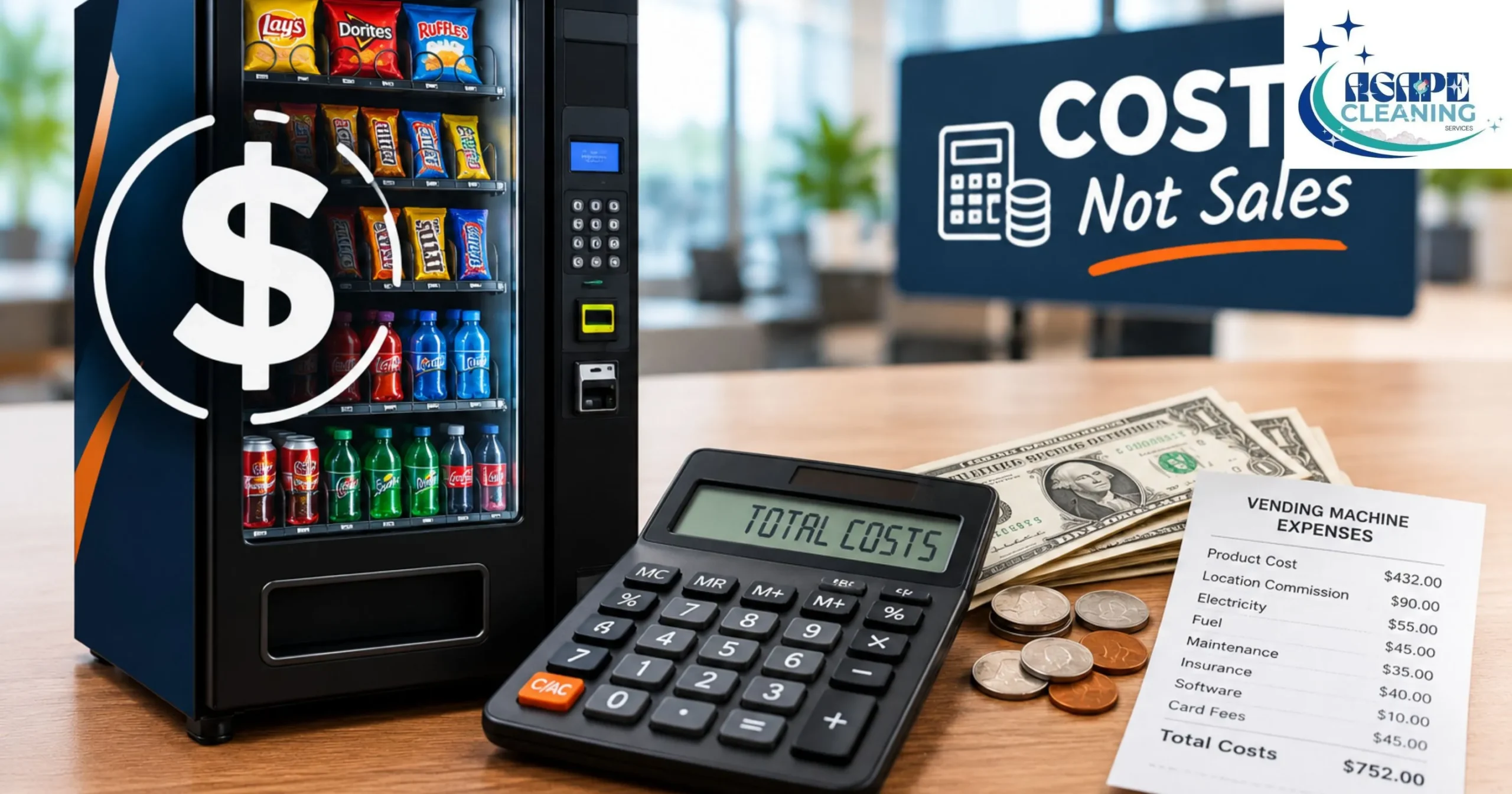
Line Item | What It Is | Monthly Cost |
Gross sales | What the machine brought in | $900 |
Product cost | Snacks and drinks (48%) | –$432 |
Location commission | The office takes 10% | –$90 |
Card processing | Fees on card sales | –$45 |
Electricity | California power rates | –$55 |
Fuel | Weekly restock drives | –$45 |
Insurance | Liability share | –$40 |
Software | Remote monitoring | –$10 |
Maintenance + shrink | Repairs and small losses | –$35 |
Your take-home | What is actually yours | $148 |
So that $900 machine really hands you around $148 a month before you count your own time. That is not bad for one machine. But it is a long way from $900, and that gap is the whole reason this article exists. Now picture ten of these humming along across your route. Suddenly, the small stuff- the fuel, the power, the commission- is the difference between a nice side income and a frustrating treadmill.
The One Number Smart Operators Watch
Here is a pro tip that took my Fresno friend a year to learn. Instead of stressing over every single bill, watch your operating costs as a percentage of your sales. It is the fastest way to know if a machine is healthy.
The vending industry has a handy benchmark here. The folks who track this stuff say a well-run operation keeps its operating costs (not counting the product itself) under about 15% of total sales. Add product on top, and your total costs usually land around 65% to 80% of sales, leaving you that familiar 20% to 35% net profit.
Why does this matter? Because it turns a messy pile of bills into one simple scoreboard. If a machine’s costs are creeping past that line, something is wrong. Maybe the location commission is too greedy. Maybe you are driving too far for too little. Maybe the power bill on an old machine is out of control. The percentage tells you where to look before the machine quietly bleeds you dry.
Check this number every month. It is the single habit that separates operators who grow from operators who give up.
How to Shrink These Costs (Without Cutting Corners)
Knowing your costs is step one. Trimming them is where the real money is. Here are the moves that work best for California operators, in plain terms.
Buy smarter, not more
Your product cost is your biggest lever. Open a real distributor account or shop the wholesale clubs. Do not panic-buy a giant case of something that expires before it sells. Spoiled stock is just money in the trash.
Negotiate the commission
Everything is negotiable. Offer a flat monthly rent instead of a percentage at a high-traffic spot, and you keep more as sales grow. At quieter sites, pitch the machine as a free perk for staff and aim for zero commission. Plenty of California offices say yes.
Cluster your route
This is the big one in a state this spread out. Eight machines packed into one neighborhood beat twelve machines scattered across three counties. Tight routes mean less fuel, less time, and fewer gray hairs.
Go energy efficient
As we covered, California power is brutal. An ENERGY STAR machine and a simple power-down sensor pay for themselves here faster than almost anywhere else.
Let software do the driving
Remote monitoring costs a few dollars a month but stops you from burning gas on a machine that did not need you. In California traffic, skipping one pointless trip is a small victory.
Price for convenience
Nobody expects vending prices to match the grocery store. A fair bump on each item quietly covers your card fees and then some. People happily pay a little extra for a cold drink exactly when they want it.
Bottom Line
That is the whole secret. Vending is a good business, but only when you treat the costs as seriously as the sales. Now that you have vending machine operating costs explained from top to bottom, you are already ahead of most people who jump in blind.
If you are ready to start a route in California, or you want to grow the one you have without the guesswork, that is exactly what we do.
At Agape Vending Machines, we help operators across California place the right machines in the right spots and keep the running costs low. Reach out to our team and let us build a route that actually pays. Want to run the numbers yourself first? Use our vending machine profit calculator to see what your route could earn, or browse the rest of our vending business guides for tips on locations, products, and profit.