Micro Market vs. Vending Machine: Which One Fits Your Workplace?
If your break room is getting complaints- not enough variety, machine’s always jammed, nothing healthy you’ve probably run into the micro market vs. vending machine question. The short answer: vending machines fit smaller spaces, lower headcounts, and tighter budgets, while micro markets fit larger, higher-traffic locations that can support a bigger upfront investment and more square footage. Neither one is universally better. The right choice depends on how many people you’re feeding, how much room you have, and how much you’re willing to invest before you know it’ll pay off.
This guide breaks down exactly what separates the two, where each one genuinely wins, and how the decision usually plays out for California offices, gyms, schools, and healthcare facilities, the kinds of locations that don’t always match the 200-person tech campus most vending comparisons are written for.
What Is a Vending Machine?
A vending machine is a self-contained unit that dispenses individual snacks, drinks, or combo items through a coil or drop mechanism, usually behind a glass front. Products are selected, paid for, and released in one transaction. A smart vending machine adds cashless payment (card, Apple Pay, Google Pay), remote inventory tracking, and telemetry that alerts the operator when it’s time to restock, but the underlying model stays the same: one machine, packaged goods, a single-item transaction.
Vending machines work well because they don’t ask much of the location. There’s no ongoing management on the business’s end, minimal footprint, and the machine can go almost anywhere there’s an outlet and a few feet of wall space. That makes vending the default option for gyms, waiting rooms, apartment common areas, warehouses, and offices of almost any size.
What Is a Micro Market?
A micro market is an open, self-service retail space, open shelving, refrigerated coolers, sometimes a freezer, and a self-checkout kiosk, installed inside a break room, lobby, or common area. There’s no glass and no coil. Employees or visitors walk in, browse like they would in a small convenience store, pick up multiple items including fresh food, and check out themselves using a card or mobile payment at the kiosk.
Because there’s no dispensing mechanism limiting product size or shape, micro markets can carry a much wider mix: salads, sandwiches, fruit, yogurt, frozen meals, and specialty drinks alongside the usual snacks. That variety is the main draw, but it comes with a trade-off: more space, more upfront setup, and an honor system element that depends on the location being reasonably secure and closed to the general public.
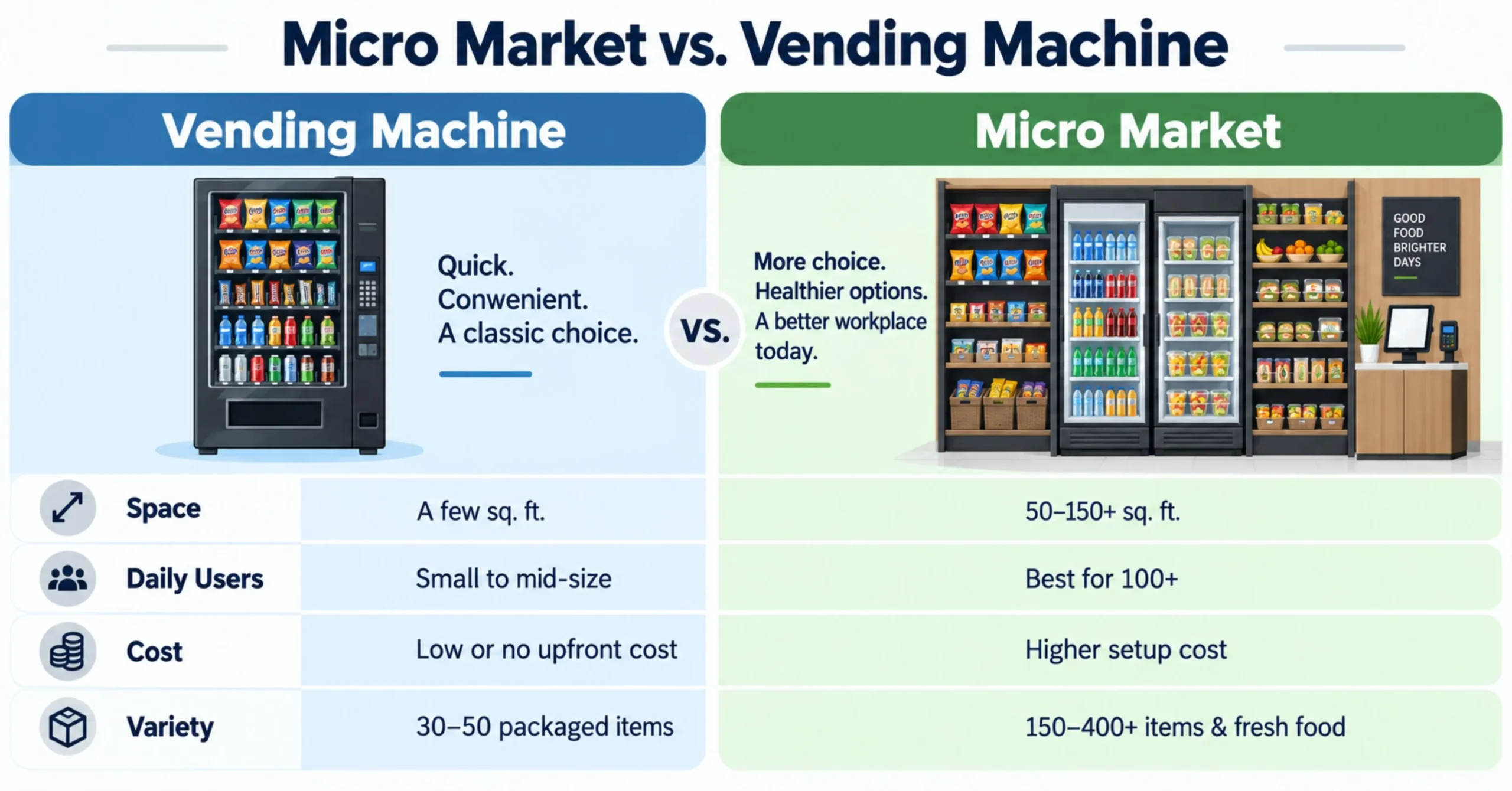
Micro Market vs. Vending Machine at a Glance
Factor | Vending Machine | Micro Market |
Typical space needed | A few square feet of wall space | Roughly 50–150+ sq ft, depending on layout |
Ideal headcount / daily users | Works from a handful of people up | Generally most cost-effective with 100+ regular daily users |
Product variety | Around 30–50 packaged items | 150–400+ items, including fresh food |
Fresh food capability | Very limited | Strong — coolers and freezers support real meal options |
Upfront investment | Low; often free with a managed vending program | Higher; commonly a five-figure build-out for coolers, shelving, and a kiosk |
Security/shrinkage risk | Low — items are locked until purchased | Requires a closed-loop, camera-monitored environment |
Best-fit environments | Small-to-midsize offices, gyms, schools, apartments, waiting rooms | Large offices, corporate campuses, hospitals, universities |
Access | Works anywhere, high or low traffic | Best in secure, closed-access spaces |
The Factors That Actually Decide This
Space Requirements
Vending machines need almost nothing, a stretch of wall and an outlet. Micro markets need a dedicated area, commonly cited in the 50–150 square foot range depending on how much shelving, cooler space, and kiosk footprint you want. A cramped or oddly shaped break room can rule out a micro market before cost even enters the conversation.
Employee or Visitor Count
This is usually the deciding factor. Vending scales down to almost any headcount; a 10-person office and a 300-person office can both run vending. Micro markets scale the other direction: the self-checkout kiosk and the wider product mix only pay for themselves when enough people are using the space daily. Most guidance in the industry points to somewhere around 100 or more regular daily users as the point where a micro market starts to make financial sense, though smaller “nano” configurations exist for offices in the 40–75 person range.
Product Variety and Fresh Food
If your team wants real meals, not just snacks, a micro market is the only format that genuinely delivers that. Vending coils and drop mechanisms can’t hold a sandwich or a fresh salad without crushing it. A smart vending machine with a refrigerated section can offer some cold items, but it won’t come close to a micro market’s open-cooler variety.
Upfront Cost and Who Pays For It
This is where the two models diverge sharply. Vending, especially through a managed, zero-cost program, typically costs the business nothing to install; the operator supplies, stocks, and maintains the machine and earns revenue through sales. Micro markets require a real capital investment in coolers, shelving, a checkout kiosk, and security infrastructure, which is why they commonly run into the five-figure range before a single item is sold. Some operators absorb that cost in exchange for a longer contract or an ongoing revenue share, but the location is usually asked to commit more, in space, traffic, or contract length, to make that math work.
Security and Shrinkage
Vending machines are effectively theft-proof; nothing dispenses without payment. Micro markets rely on trust plus deterrents, cameras, product tagging, and sometimes AI-based loss-prevention software, which is why they’re recommended almost exclusively for closed-loop environments: offices, hospitals, and campuses where the people using the space are known, badge-access-controlled, or otherwise not open to walk-in public traffic. A retail lobby open to the public is a poor fit for a micro market regardless of size.
Payment and Technology
Both formats now commonly support cashless payment. The real technology difference is the checkout experience itself: a vending machine is a single dispense-and-pay transaction, while a micro market’s kiosk needs to ring up a full basket the way a small store would, which adds setup and software complexity on the operator’s side.
24/7 Access
Micro markets are typically open around the clock since there’s no attendant and nothing is locked behind glass. Vending machines offer the same always-available access; this is one area where the two formats are essentially tied.
Which Is Better for Small and Mid-Size California Businesses?
Most of the businesses actually asking this question, a Palm Desert or Coachella Valley office, a local gym, a school, an apartment complex, a medical office- aren’t 200-person corporate campuses. They’re smaller, closed-loop locations where the space and headcount thresholds above point toward vending, particularly smart vending, as the more realistic fit: low or no upfront cost, minimal space commitment, and a setup that can be installed in a week or two rather than requiring a capital project.
That doesn’t mean micro markets are irrelevant in California; large employers, hospital systems, and university campuses are exactly the kind of high-traffic, closed-access environments where a micro market earns its investment. But for the majority of small-to-midsize workplaces, the honest starting point is a well-stocked, cashless-ready vending setup that can always be expanded or supplemented later as headcount grows.
When a Micro Market Makes Sense
A micro market is usually the right call when a location has:
- 100 or more regular daily users – enough consistent foot traffic to justify the investment
- A closed, secure space – badge access, cameras, or a workforce that isn’t open to walk-in public traffic
- At least 50–150+ square feet available in a break room, lobby, or common area
- Demand for real food, not just snacks – teams that want salads, sandwiches, and fresh options
- Budget or a willingness to commit to a longer-term vendor agreement that covers the higher build-out cost
When a Vending Machine (or Smart Vending Machine) Makes More Sense
Vending, particularly a modern, cashless smart vending machine, is the better fit when a location has:
- A smaller or fluctuating headcount, where a big fixed investment doesn’t make financial sense yet
- Limited space, down to a single wall or corner
- Mixed public and private access, like a gym lobby, apartment common area, or waiting room, where an open-shelf format carries more shrinkage risk
- A preference for zero upfront cost, with the operator handling installation, stocking, and maintenance
- A need to get something in place quickly– vending installations typically move faster than a micro market build-out
Common Mistakes Businesses Make When Choosing
Sizing the format to the office instead of the daily user count
A large office with low daily break-room traffic can still be a poor micro market fit, and a smaller office with consistently high foot traffic can outgrow vending faster than expected.
Assuming the more "premium" option is automatically the better one
A micro market that goes underused because the headcount doesn’t support it becomes an expensive, half-stocked shelf, not an upgrade.
Skipping the security conversation
Installing an open-shelf micro market in a space with public walk-in access, without cameras or access control, invites shrinkage that can quietly erase the profitability advantage micro markets are supposed to offer.
Not asking who pays for what
Some vendors present a micro market as a zero-cost option; the fine print often involves longer contracts, minimum sales commitments, or shared investment. It’s worth getting exact terms in writing before comparing “cost” across the two models.
A Simple Way to Decide
Answer these four questions honestly:
1. How many people will realistically use this space every day?
Under roughly 100, lean vending. Over that, a micro market becomes worth evaluating.
2. How much square footage can you actually dedicate?
If it’s a single wall, vending is the only real option.
3. Is the space closed-loop and monitored, or open to the public?
Open access strongly favors vending’s built-in security.
4. Do you want zero upfront cost and a fast install, or are you prepared for a bigger build-out in exchange for more variety?
This alone resolves most of the decision.
If most of your answers point toward smaller, faster, lower-commitment, a modern smart vending setup will almost always outperform a micro market that’s oversized for the location, both in cost-effectiveness and in how well-stocked it stays.
The Bottom Line
There’s no universally better option between a micro market and a vending machine, only a better fit for a specific space, headcount, and budget. For the majority of small and mid-size California workplaces, offices, gyms, schools, apartment communities, and medical facilities, a modern, cashless smart vending machine installed at no upfront cost hits the space, security, and speed requirements that a micro market build-out often can’t justify until headcount grows well past 100 regular daily users.
If you’re weighing this decision for a Coachella Valley business, Agape Vending Machines can assess your space and tell you honestly whether vending fits- no pressure, no cost to find out.
Frequently Asked Questions
A vending machine dispenses single packaged items through a machine. A micro market is an open, self-checkout retail space where people can browse and select multiple items, including fresh food, before paying at a kiosk.
There is no strict rule, but most industry guidance suggests around 100 or more regular daily users for the investment to make sense. Smaller nano micro markets can work for offices with 40–75 people, although vending machines are usually more cost-effective for smaller locations.
It can be more profitable because customers often purchase multiple items and fresh food may offer better margins. However, the location needs enough regular traffic. A micro market in a low-traffic location may perform worse than a well-managed vending machine program.
Costs vary depending on the size and equipment. A complete micro market with coolers, shelves, a payment kiosk, and security features may cost five figures. Vending machines provided through a fully managed program typically cost the business nothing to install.
Micro markets use security measures such as cameras, product tagging, and sometimes AI-based monitoring. However, the open-shelf and self-checkout setup still carries some theft risk. For this reason, micro markets work best in closed and secure environments.
Yes. A small office can use a scaled-down nano micro market. However, a well-stocked smart vending machine may be more practical because it usually costs less to install and does not require the same security setup.