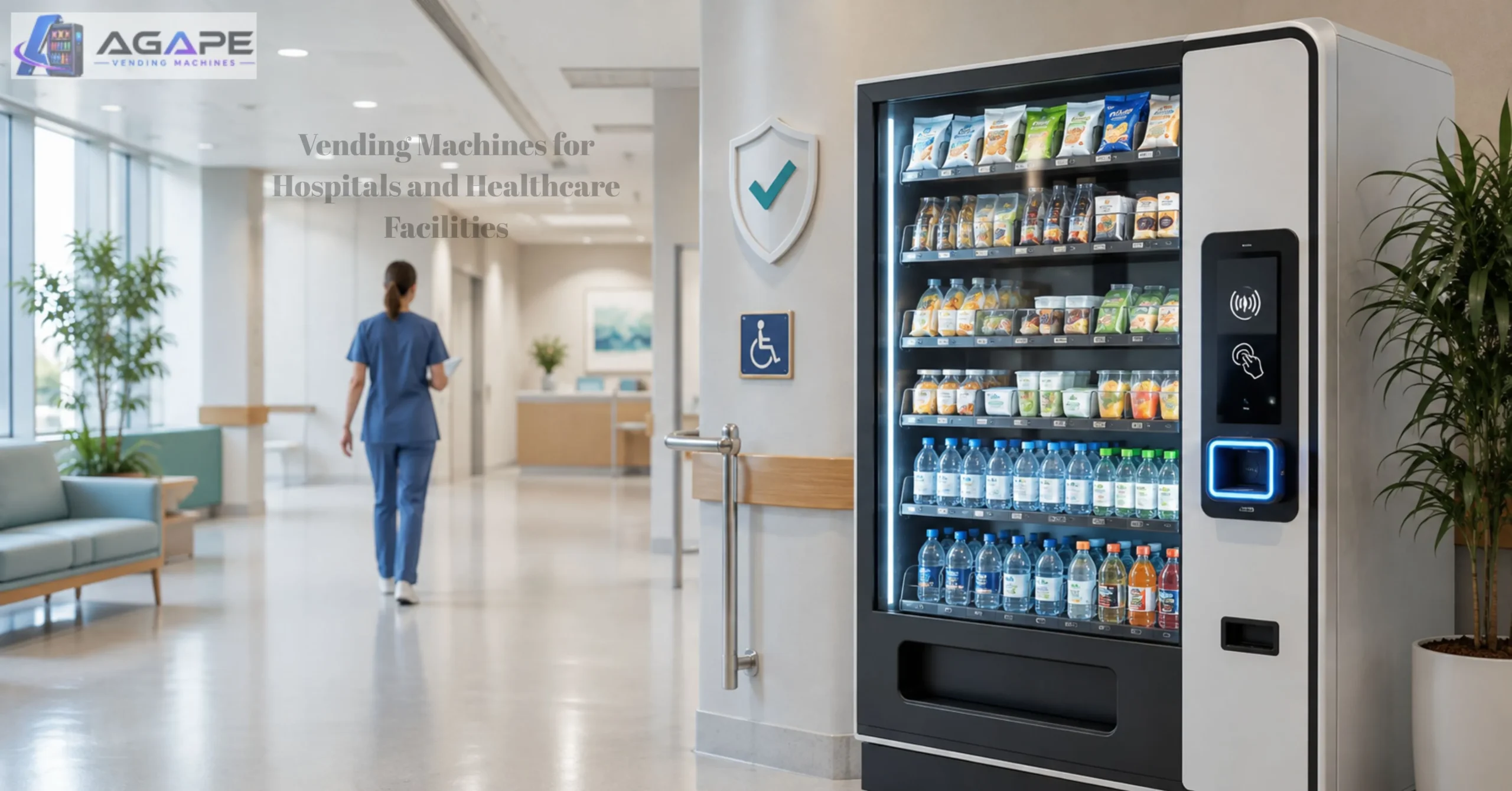
Vending Machines for Hospitals and Healthcare Facilities: Compliance & Best Options
It’s 2:47 a.m. at a mid-sized hospital somewhere between Sacramento and the Bay. A nurse named Priya has been on her feet since 7 p.m. She’s just walked out of a room where a patient’s blood pressure dropped hard enough to pull three people off their scheduled rounds. Her break window is short and unpredictable, the hospital dining hall isn’t running at this hour, and the nearest off-site option is a fifteen-minute round trip she doesn’t have. What she has, thirty feet from the nurses’ station, is a well-lit machine stocked with string cheese, a banana, and a cold brew.
That machine isn’t a perk. For a lot of overnight staff, it’s the only realistic food access they have during a break that might get cut short at any moment.
If you run facilities, food service, or procurement for a California hospital, or you’re a vending operator trying to win that contract, you already know this scenario plays out constantly. This article looks at why hospital vending has become such a meaningful piece of facility planning, what it typically takes to do it well in a California hospital specifically, and how to think through the decision if you’re the one signing off on a vendor.
Why Hospitals Aren't Like Other Vending Environments
Ask any operator who services both office parks and hospitals, and they’ll tell you these are genuinely different environments to plan around. Many office buildings empty out by evening and stay quiet through the weekend. A hospital, by contrast, runs continuous shifts around the clock, which changes what convenient food access even means.
That distinction matters. A hospital vending program has to account for:
- Shift patterns that never fully stop. Twelve-hour rotations mean someone is often on a break at 4 a.m., not just noon.
- A population that includes patients, not just staff. Dietary needs aren’t a nice-to-have; for some patients, they’re clinically important, which is a different bar than a typical office breakroom has to clear.
- High emotional stakes. A family member who’s been in a waiting room for many hours isn’t casually shopping for snacks. A cold bottle of water at the right moment can matter more than it sounds like it should.
- Facility-specific standards. Infection control, accessibility, and food-safety expectations that a typical corporate breakroom doesn’t have to think through in the same way.
A vending machine in an office breakroom is a convenience. A vending machine in a hospital corridor tends to function as a small but real piece of facility support, one that also happens to sell trail mix.
Cafeterias Cover a Lot, But Not Everything
Most hospitals run some form of dining service, and many extend hours further than a typical office cafeteria would. Even so, dining services are centralized by nature, one or two locations serving an entire campus, and they can’t be everywhere a break happens to fall, at whatever hour it happens to fall. That’s the gap hospital vending is generally built to help close: not replacing food service, but extending access into the hours and corners of the building that centralized dining can’t fully reach on its own.
The California Factor: What Makes This State Different
Here’s where things get specific. California isn’t just a big state with a lot of hospitals. It has its own regulatory landscape, its own labor rhythms, and its own geography to account for.
1. California's Meal and Rest Period Rules Are Strict — But Vending Isn't a Compliance Tool
California law requires qualifying meal and rest periods for most employees, including healthcare workers, and the state has specific provisions covering meal periods in healthcare settings. It’s worth being precise here: installing vending machines does not itself satisfy any legal meal-or-rest-break requirement, and no facility should treat it that way. What on-unit vending can do is support practical food access during the breaks employees are already entitled to, which matters in a setting where those breaks are frequently interrupted or compressed by patient emergencies. For the actual legal requirements, the California Labor Commissioner’s guidance on meal periods is the authoritative source, and any facility with compliance questions should work from that directly rather than from vending marketing material.
2. Real Estate and Distance Are a California-Specific Consideration
In Los Angeles, a hospital campus can span the footprint of a small neighborhood. In San Francisco, parking alone can eat into a short break. In parts of the Central Valley or the North Coast, the nearest off-site option might be a genuine drive, not a walk. California’s geographic range, dense urban campuses in LA and the Bay Area, and more isolated regional hospitals in places like Chico, Eureka, and Redding mean that leaving campus for food is a very different proposition depending on where in the state a facility sits.
3. Expectations Around Food Quality Have Shifted
California has a strong regional culture around fresh food and label-conscious eating, and hospital staff and visitors here generally expect more than a machine full of candy and soda. A vending program that leans toward protein bars, fresh-adjacent options, and lower-sodium choices tends to land better with this audience than a purely legacy snack mix, though this is a matter of fit and preference, not a formal standard.
4. Major Health Systems Set Their Own Bar
California’s hospital landscape includes several large, established systems, Kaiser Permanente, Sutter Health, Dignity Health, UC-affiliated medical centers, and Cedars-Sinai among them, organizations with substantial procurement processes and their own internal standards for vendors operating inside their facilities. Systems of this size typically evaluate vending less like a small office manager would and more like any other facility vendor: with attention to liability, consistency across campuses, and the vendor’s ability to actually scale and service multiple sites reliably.
5. One State, Several Different Hospital Realities
California isn’t a single market, and a vending approach built for a downtown Los Angeles trauma center won’t necessarily fit a 90-bed hospital in the Sierra foothills.
- Bay Area and Silicon Valley campuses operate in a labor market where nearby tech employers often offer subsidized food and micro-kitchens, which can shape staff expectations even though hospital vending isn’t trying to replicate a corporate campus perk.
- Los Angeles and the broader Southland deal with large campus footprints and traffic that can make leaving the building for food a genuinely costly use of a short break.
- Central Valley cities like Fresno, Bakersfield, and Chico often have hospitals that function as major local employers, sometimes with fewer nearby off-site food options than an urban facility would have.
- Rural and North Coast facilities — Eureka is one example can be the primary medical center for a wide surrounding area, where nearby retail options may have limited overnight hours.
A vending partner who understands these differences will typically approach a Fresno hospital and a San Francisco hospital differently, since the surrounding food landscape, budget context, and staff expectations aren’t uniform across the state.
What a Well-Run Hospital Vending Program Tends to Include
If you’re evaluating a hospital vending program, whether as buyer or vendor, a few elements tend to separate programs that work well from ones that become a maintenance headache.
A Product Mix Built Around Multiple Audiences
A hospital vending machine typically serves at least three different groups, and they don’t all want the same thing:
- Staff on shift generally benefit from quick, protein-forward, lower-sugar options, think protein bars, string cheese, trail mix, or coffee, food intended to sustain a long shift rather than cause an energy crash partway through.
- Patients, where their care team allows it, may need low-sodium or low-sugar options. It’s worth being clear that any therapeutic diet, including textures modified for swallowing difficulty, should come from clinical nutrition or speech-language pathology, not a vending machine. Vending can complement an approved general diet; it isn’t a substitute for clinically managed nutrition.
- Visitors and families are often stressed or fatigued, and a reasonable mix of comfort items alongside healthier choices tends to serve this group well.
A vending program built with all three groups in mind, rather than defaulting to a standard office snack mix, tends to serve a hospital population more effectively.
Uptime and Maintenance Matter More Than the Menu
Facilities staff often say the same thing: what actually damages a vending relationship isn’t the snack selection; it’s a machine that fails at a bad moment, like 4 a.m., for an already-exhausted staff member. A single bad experience can sour people on the whole program.
A vendor working in a hospital setting generally needs:
- Reasonably fast response times for outages.
- Some form of inventory monitoring, so machines are less likely to run empty during predictable demand periods.
- Cashless or contactless payment options, which are increasingly common across vending generally and particularly convenient for staff working in scrubs.
Placement Strategy
Where machines are placed matters nearly as much as what’s inside them. Reasonable placement often includes:
- Near nurses’ stations and staff lounges, for shift workers who can’t easily leave the floor.
- In waiting areas near units where families tend to wait for extended periods, such as ICU or labor and delivery.
- Near main entrances and emergency department waiting areas.
- Positioned with attention to noise and any relevant infection-control considerations near clinical zones.
Regulatory and Facility Requirements
Vending inside a hospital isn’t regulated identically everywhere, and the specifics depend on the products involved, the type of machine, and the local enforcement authority. A few things worth knowing:
- Accessibility. Federal ADA standards, administered through the U.S. Access Board, address specifics like accessible routes to the machine, clear floor space, reach ranges for controls, and operable parts. These are technical, specific requirements, not a blanket rule that every machine in every facility must be identical, but real standards that any hospital-serving vendor should be familiar with and able to meet.
- Food safety and licensing. In California, retail food matters are generally overseen by local environmental health departments, and the state separately licenses water vending operators through the California Department of Public Health. The applicable rules can vary by product type and jurisdiction, so it’s worth confirming specifics with the relevant local authority rather than assuming a single statewide rule covers every case. See CDPH’s licensing information for more on water vending
- specifically.
- Infection control. Placement near clinical areas is typically guided by the hospital’s own infection-control protocols, which can vary by facility.
Vendors who’ve worked inside California hospitals tend to be familiar with this patchwork and can speak to it specifically, rather than offering vague reassurances.
The Technology Layer
Hospital vending has moved beyond “stock the machine and keep it full.” Many programs now include some combination of:
- Remote inventory tracking, intended to flag low stock on popular or specialty items before a machine runs empty.
- Cashless and mobile payment, increasingly common industry-wide and particularly practical for staff without easy access to cash or cards.
- Usage data, which can help a vendor recognize predictable demand patterns, like an overnight surge on a surgical floor, and adjust restocking accordingly.
- Temperature monitoring for machines carrying perishable items such as fresh fruit or yogurt, which matters more in a healthcare setting than in most other vending environments.
None of this is flashy, and it isn’t universal across every vendor or every machine. But in a state where hospital systems already run sophisticated logistics for everything from pharmaceuticals to linens, a vending partner still relying on manual, guess-and-check restocking is likely to stand out as behind the curve.
Revenue Share: A Real Consideration, With Real Variation
Some hospitals structure vending arrangements around a commission or revenue-share model, where the facility earns a percentage of sales in exchange for hosting the machines. Results vary significantly by facility size, foot traffic, and product mix, and any specific revenue figures should come from a hospital’s own vendor agreement rather than industry averages, since outcomes differ widely from one facility to the next. What’s reasonably consistent is the trade-off worth asking about upfront: vendors who lean toward healthier, better-supported product mixes don’t always maximize short-term impulse sales the way sugar-heavy machines might, so it’s worth having a direct conversation with any prospective vendor about how they balance revenue goals against a facility’s own wellness priorities, and asking for references or data specific to comparable hospitals rather than general claims.
Choosing a Vending Partner: What to Actually Ask
If you’re making this decision for a California facility, a few direct questions tend to be more useful than a sales pitch:
- Do you already service hospitals, or would this be a first? Healthcare vending has different considerations than a warehouse breakroom, and experience tends to show.
- What’s your typical response time for a down machine? Ask for a specific number, not a general assurance.
- Can the product mix be customized by unit or floor? An ICU staff lounge and a maternity ward waiting area may not need identical machines.
- How do you approach California-specific requirements — accessibility, food safety licensing, and facility infection-control protocols?
- What does your restocking cadence look like, and is it informed by actual usage data or a fixed schedule that might miss predictable surges?
- Do you offer a revenue-share or commission model, and how transparent is the reporting behind it?
A vendor who can answer these specifically, with real numbers and real examples from comparable facilities, is generally worth taking seriously. A vendor who only talks about snack brands usually isn’t ready for a hospital contract.
The Bigger Picture
It’s easy to underrate hospital vending because it’s unglamorous; nobody puts installed vending machines in an annual report highlight reel. But talk to enough nurses, ER techs, or family members waiting through a long night, and it becomes clear this is one of those pieces of infrastructure that’s mostly invisible until it isn’t there.
California’s hospitals face a particular version of this challenge: sprawling campuses in some regions, real isolation in others, strict labor protections that make food access during breaks a meaningful practical concern even though vending itself isn’t a compliance measure, a public that tends to expect thoughtful nutrition options, and major health systems that expect professional, compliant vendor relationships. A vending program built with those specifics in mind isn’t a minor operational detail; it’s a small but real part of how a California hospital supports the people inside it, around the clock.
Get the product mix right, keep the machines running, and place them where people actually need them, and a well-run program becomes one of the quieter things that makes a demanding building a little easier to work and wait in.
Frequently Asked Questions
No. Vending isn't a legal requirement, though it can support food access during required breaks.
Protein bars, fresh options, and lower-sodium choices tend to suit staff, visitors, and general patient use.
Often yes, through commission or revenue-share agreements, though results vary by facility and traffic.
Yes—federal ADA rules cover accessible routes, floor space, reach ranges, and operable controls.
Ideally, restocking should be based on real usage patterns, since demand can spike unpredictably during overnight periods.