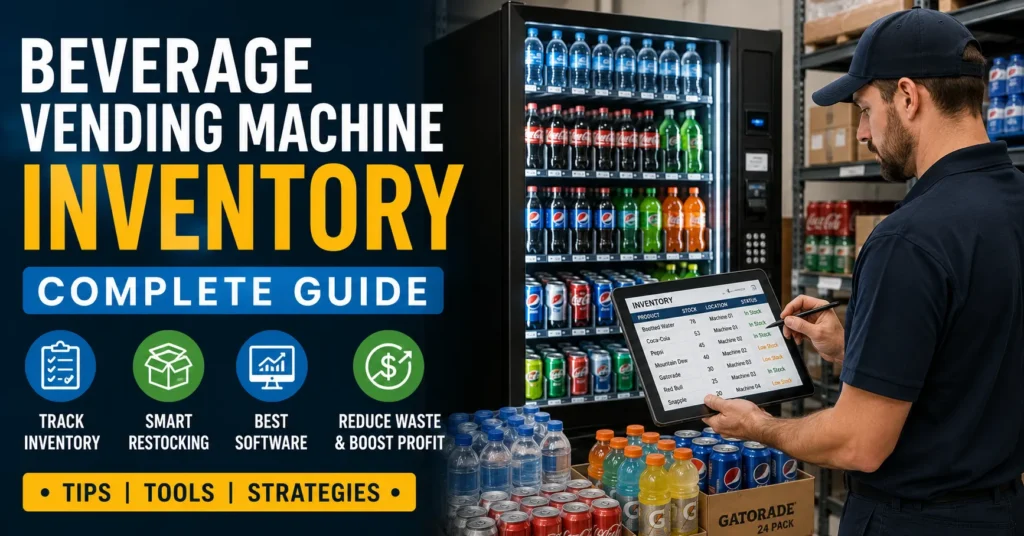
Beverage Vending Machine Inventory: The Complete Management Guide for 2025
Most vending operators think their biggest problem is finding good locations. It isn’t. It’s running out of Coca-Cola on a Tuesday afternoon, and not knowing until they show up three days later to restock.
Beverage vending machine inventory management is what separates operators who build profitable routes from those who constantly chase their tails. Get it right, and your machines run lean, stay full, and earn consistently. Get it wrong, and you’re either throwing money at expired stock or losing sales to empty slots.
This guide covers everything: what smart inventory management actually looks like, which software tools make it easier, how to forecast demand by location, and the mistakes that quietly drain your margins every month.
Beverage vending machine inventory management means tracking which drinks you have in each machine, how fast they sell, when to restock, and how much to order. The best operators use vending management software (VMS) such as Parlevel, VendSoft, or Cantaloupe to automate tracking, receive low-stock alerts, and optimize restock routes, thereby reducing waste, cutting trips, and increasing monthly revenue per machine.
What Is Beverage Vending Machine Inventory Management?
It’s knowing exactly what’s in every machine, what’s selling, what’s sitting, and what you need to bring on your next service run.
For a single drink vending machine, you might manage this with a clipboard. For a 20-machine route stocked with Pepsi, bottled water, energy drinks, juice, and sports drinks across five different locations, you need a system.
Inventory management for beverage vending machines covers three distinct areas:
- In-machine stock tracking: what's currently loaded in each slot
- Warehouse inventory: what you have on hand before your next restock run
- Order management: when and how much to reorder from wholesale beverage suppliers
Modern operators use IoT-connected machines or vending management software (VMS) to handle most of this automatically. Traditional operators still rely on paper logs and gut instinct, consistently leaving money on the table.
Why Most Operators Get Inventory Wrong
Here’s the reality: the two most common inventory problems in vending are exact opposites, and most operators struggle with both simultaneously.
Problem | What Causes It | What It Costs You |
Stockouts (Empty Slots) | Infrequent restocking, inaccurate | Lost sales opportunities, frustrated customers, |
Overstocking | Ordering excessively slow-moving | Expired drinks, tied-up cash |
Poor Product Selection | Choosing products based on assumptions instead of location-based buying behavior | Lower sales volume, weak profit margins, and reduced customer engagement |
Unplanned Service Trips | Lack of real-time inventory tracking and inefficient route planning | Increased fuel expenses, wasted labor hours, and reduced operational efficiency |
The fix isn’t complicated, it’s systematic. You need visibility into your machines and a process for acting on the data they provide.
The 4 Core Pillars of Drink Vending Inventory Control
Pillar 1: Real-Time Stock Visibility
You can’t manage what you can’t see. Smart vending machines equipped with IoT sensors or DEX telemetry send live stock data to a cloud dashboard. You can see exactly how many units of each SKU remain in each machine, without driving to the location.
This is the single biggest operational upgrade available to beverage vending operators in 2025. Platforms like Parlevel OnTrack and Cantaloupe Seed pull real-time inventory data from connected machines, eliminating the guesswork that kills margins.
Pillar 2: Restocking Route Optimization
When should you service each machine? The answer shouldn’t be ‘every Tuesday.’ It should be ‘when the data says it needs you.’
Route optimization software groups your lowest-stock machines by location, plans the most fuel-efficient service order, and ensures you bring only what each machine actually needs. VendSoft is particularly good at this for small- to mid-sized operators; it builds route sheets that tell each driver exactly what to load, in what order, at each stop.
Pillar 3: Demand Forecasting
Your vending machine in a hospital lobby doesn’t sell the same mix as the one in a college gym. Effective inventory forecasting means understanding demand at the machine level, not just averaging across your whole route.
Variables that shift demand significantly:
⦁ Location type (office, school, gym, hospital, factory)
⦁ Day of week (offices drop on weekends; gyms spike Saturday morning)
⦁ Season (cold beverage demand rises 30–40% in summer months)
⦁ Local events (a conference at a nearby hotel can double your daily vends)
Predictive analytics tools, available on platforms like Cantaloupe and Parlevel, analyze these variables and automatically surface forecasts. For operators without those tools, even a simple 4-week average sales per SKU per machine is dramatically better than guessing.
Pillar 4: Product Rotation and SKU Discipline
Every slot in a beverage machine has a cost, an opportunity cost. A slot filled with a juice that moves 3 units per week is stealing revenue from a water or energy drink that could move 25 units.
SKU management means regularly auditing your product mix and cutting underperformers. The general rule: if a product doesn’t turn at least once every four days on average, it probably doesn’t belong in that machine.
Seasonal rotation matters too. Summer demands cold beverages, electrolyte drinks, and sparkling water. Fall and winter see upticks in warm drinks and higher-calorie options. Rotating your mix by season keeps customers engaged and machines running at peak performance.
Best Vending Machine Inventory Software: Side-by-Side Comparison
You don’t need enterprise software on day one. But the right platform saves time, reduces waste, and pays for itself quickly. Here’s how the top options compare:
Software | Best For | Key Inventory Features | Price Range |
Parlevel OnTrack | Mid-to-large vending route operators | Real-time telemetry, route optimization, DEX integration, and inventory forecasting | Mid–High |
Cantaloupe Seed | Enterprise operators with 100+ machines | Advanced inventory control, live machine telemetry, cashless payment integration, and detailed analytics | High |
VendSoft | Small-to-medium vending businesses (5–100 machines) | Cloud-based inventory tracking, route management, maintenance scheduling, and sales reports | Low–Mid |
Nayax Core | Cashless and smart vending operators | Real-time stock alerts, payment telemetry, remote machine monitoring, sales analytics | Mid |
Vendon | IoT-driven vending operations | Predictive restocking alerts, machine health diagnostics, and remote inventory monitoring | Mid |
Which software is right for you?
If you’re running fewer than 25 machines, VendSoft offers robust inventory tracking and route management at an affordable price. For 25–100 machines, Parlevel is the upgrade worth considering. For large-scale enterprise operations with 100+ machines, Cantaloupe Seed or Parlevel at the enterprise tier handles the complexity. If cashless payments are your priority, Nayax integrates payment and inventory telemetry into a single platform.
How to Build a Beverage Vending Restocking Schedule That Actually Works
A restocking schedule built on calendar days is a blunt instrument. A schedule built on sales velocity data is a precision tool.
Here’s a practical framework for building a data-driven refill schedule:
1. Track sales per machine for 30 days. Even manually, this data is gold.
2. Calculate average daily vends per SKU at each machine.
3. Identify your ‘trigger point’, the stock level at which a machine needs servicing before it runs out of a top seller.
4. Set restock alerts in your VMS (or calendar reminders if manual) to fire that trigger point.
5. Build route groups based on geography, service nearby machines in the same trip.
6. Revisit the schedule every 90 days as sales patterns shift.
Machine Volume | Recommended Restock Frequency | Notes |
Low Volume (<20 vends/day) | Every 10–14 days | Use sales data consistently before extending service intervals |
Medium Volume (20–50 vends/day) | Every 5–7 days | Track fast-moving beverages weekly to avoid stockouts |
High Volume (50–100+ vends/day) | Every 2–3 days | Real-time telemetry monitoring is strongly recommended |
Premium Locations (Hospitals, Airports, Campuses) | Every 1–2 days | Consider adding a second machine or expanding beverage capacity |
Demand Forecasting for Cold Drink Vending Machines
Beverage demand forecasting sounds complex. At its core, it’s answering one question: how many of each drink will this machine sell before my next service visit?
Get that number right, and you show up with exactly the right inventory. Get it wrong, and you either leave sales on the table or haul home unsold stock.
Simple Forecasting Formula for Beverage Operators
Units needed = (Average daily vends per SKU) × (Days until next service) × 1.15 safety buffer
Example: Your Gatorade slot averages 8 units per day. Your next service visit is in 5 days. You need: 8 × 5 × 1.15 = 46 units. Round to 48 (a case). Done.
Apply this to every SKU in every machine, and your restocking becomes a math exercise, not a guessing game. Platforms like Cantaloupe and Parlevel automate this calculation across hundreds of machines simultaneously.
External Factors That Shift Beverage Demand
⦁ Weather, cold drink sales increase 30–40% during summer heat waves
⦁ Local events, conferences, sporting events, and concerts near your locations spike demand
⦁ Seasonal workforce changes, school machines see dramatic traffic shifts between semesters
⦁ Promotions, a new drink launch (think a new Pepsi or Coke flavor rollout), spike curiosity and purchases
Common Beverage Vending Inventory Mistakes — and How to Fix Them
Mistake #1: Managing All Machines the Same Way
Your hospital machine and your small-office machine are not the same business. They have different volumes, different demographics, and different product preferences. Applying the same product mix and restock schedule to both guarantees you’re over-serving one and under-serving the other.
Fix: Create individual machine profiles with their own restock triggers, product mixes, and service frequencies.
Mistake #2: Stocking by Preference, Not Data
New operators stock what they personally like, or what’s cheapest to buy. Neither correlates with what sells. A gym location might surprise you: coconut water and electrolyte drinks consistently outperform soda in fitness-focused environments, regardless of what the operator assumes.
Fix: Run a 30-day test with a broad mix, then ruthlessly cut the bottom 20% of SKUs by turn rate.
Mistake #3: Ignoring Expiration Dates
Beverages aren’t shelf-stable forever. Premium juices, cold-brew coffees, and functional drinks often carry shorter shelf lives than standard soda. Loading a machine with 60 units of a drink that expires in 45 days, when you restock every 14 days, is a silent margin killer.
Fix: Apply FIFO (First In, First Out) stock rotation religiously. Load older units to the front of each slot. Track expiration dates in your VMS or a simple spreadsheet.
Mistake #4: No Warehouse Organization
Your inventory storage area is the starting point of your entire supply chain. If it’s disorganized, drinks are stacked randomly, no labeling, products are mixed by location, every restock run takes longer, and error rates go up.
Fix: Organize warehouse inventory by machine rather than by product category. Each machine gets a dedicated zone or shelf. You prep per-machine loads before driving, not while standing in front of the machine at the location.
Expert Tips to Cut Inventory Waste and Boost Monthly Revenue
Tip 1: Use the 80/20 Rule on Your Product Mix
In most beverage vending machines, 20% of the SKUs generate 80% of the revenue. Find those SKUs, protect their slot allocation, and expand their facing positions. The slow movers can be tested occasionally, but they shouldn’t displace your revenue drivers.
Tip 2: Negotiate Min/Max Orders with Your Wholesale Supplier
Work with your beverage distributor to set flexible order quantities tied to your actual demand data. Avoid locking yourself into large minimum orders for products with inconsistent turn rates. The best wholesale beverage supplier relationships are built on data sharing; show them your sell-through rates and negotiate accordingly.
Tip 3: Monitor Your Cashless Payment Data as an Inventory Signal
Platforms like Nayax and Cantaloupe generate transaction-level data every time someone buys a drink. This is your most granular demand signal. A spike in Gatorade sales on Friday afternoons at your gym location tells you to load extra heading into the weekend. Use your cashless payment data as an inventory planning tool, not just a revenue report.
Tip 4: Build a 'Par Level' for Every Machine
A par level is the minimum stock level at which a machine triggers a restock. Setting par levels by SKU and machine, and automating alerts through your VMS, eliminate reactive, last-minute service runs. It also prevents the scenario where your best machine runs out of its top seller three days before your scheduled visit.
Tip 5: Photograph Each Machine on Every Service Visit
This takes 30 seconds and pays dividends. A dated photo of each machine’s planogram documents what was stocked, catches slot drift (products moved to the wrong coils), and provides a visual record for troubleshooting customer complaints about unavailable items.
What is beverage vending machine inventory management?
Beverage vending machine inventory management is the process of tracking stock levels in each machine, forecasting demand by location, scheduling restocking visits, and managing warehouse inventory to minimize waste and prevent stockouts. Effective inventory control uses vending management software (such as Parlevel, VendSoft, or Cantaloupe) to monitor real-time stock data, optimize service routes, and rotate products based on sales velocity. The goal is to keep machines fully stocked with the right beverages while reducing unnecessary service trips and losses from expired product.
FAQ: Beverage Vending Machine Inventory
You can track inventory manually using a log sheet during each service visit, or automatically using vending management software (VMS) connected to your machine's telemetry or DEX port. Software like Parlevel or VendSoft provides real-time stock visibility across all machines from a single dashboard, no physical visit required.
Restock frequency depends on sales volume. Low-volume machines (fewer than 20 vends per day) typically need restocking every 10–14 days. High-volume machines in hospitals, airports, or large office buildings may need restocking every 1–3 days.
A strong beverage mix for most locations includes still water, sparkling water, Coca-Cola or Pepsi, Diet Coke or Pepsi Zero, sports drinks (Gatorade or Powerade), at least one energy drink (Monster or Red Bull), and a juice option.
Parlevel OnTrack and VendSoft consistently rank as the top inventory management platforms for vending operators. Parlevel works best for larger operations, while VendSoft is ideal for smaller vending businesses.
Set par level alerts for your top-selling SKUs. With vending management software, alerts are automated. Without software, use calendar reminders based on your average daily sales.
FIFO stands for First In, First Out. In vending, it means loading older inventory to the front of each slot so it vends before newer stock and prevents expired products.
Ready to Run a Tighter Beverage Vending Operation?
Whether you’re managing your first drink machine or optimizing a 30-machine route, inventory control is the discipline that compounds over time. A few percentage points less waste. A few fewer wasted service trips. A few more units were sold per week. It adds up to real money.
At Agape Vending Machines, we work with operators at every stage, helping you choose the right equipment, set up for efficient inventory management from day one, and scale without losing control of your operations.
Explore our beverage vending machine options, or reach out to discuss your route setup. No pressure, just practical guidance from people who know the business.