How Much Does It Really Cost to Start a Vending Machine Business in California?
If you’ve spent any time researching this, you’ve probably seen wildly different numbers. One article says you can start for $3,000. Another says you need $50,000. Neither one is lying to you, they’re just describing different businesses that happen to share the word vending.
Here’s the honest range: most people getting into vending in California with one or two machines are looking at somewhere between $5,000 and $15,000 to actually open for business, once you count the machine, the permits, the first round of inventory, and the small costs nobody mentions until you’re already paying them. Go bigger, multiple machines, a route, smart vending tech, and that number climbs into the $30,000–$100,000+ range.
The rest of this comes down to one question: which version of this business are you building? Let’s break down exactly where the money goes.
The Real Cost Breakdown, Line by Line
Before the deep dive, here’s the shape of it:
Cost Category | Typical Range (California) |
Vending machine (used, mechanical) | $1,200 – $3,000 |
Vending machine (new, standard) | $3,000 – $6,000 |
Vending machine (smart/cashless, combo) | $5,000 – $10,000+ |
Business license & registration | $50 – $200 |
Seller’s Permit (CDTFA) | Free |
Health permit (food/beverage machines) | $100 – $500, county-dependent |
General liability insurance | $300 – $1,200/year |
First inventory stock | $150 – $400 per machine |
Cashless payment reader | $200 – $500 per machine |
Transportation (truck/van rental or purchase) | $0 (if you already own one) – $20,000+ |
Storage | $0 – $150/month |
Location commission (ongoing, % of sales) | 5% – 25% |
That range is wide on purpose, a used snack machine you found on a local classifieds site and a networked, cashless-enabled combo machine from a distributor are not the same starting line.
The Machine Itself
This is the single biggest line item, and it’s also where beginners make their first real decision.
Used mechanical machines are the cheapest way in. You’ll find older snack or soda machines for $1,200–$3,000, sometimes less if you’re willing to do some refurbishing yourself. The tradeoff is obvious: more breakdowns, no cashless payment built in, and older refrigeration units that can fail at the worst possible time. If your budget is tight and you’re willing to learn basic repair, this is a legitimate way to start, plenty of successful operators bought their first machine used.
New standard machines run $3,000–$6,000 and come with a warranty, current safety and energy standards, and (usually) card reader compatibility already built in or easy to add. For someone starting a single-machine operation who doesn’t want to become an appliance repair technician on day one, this is the more predictable choice.
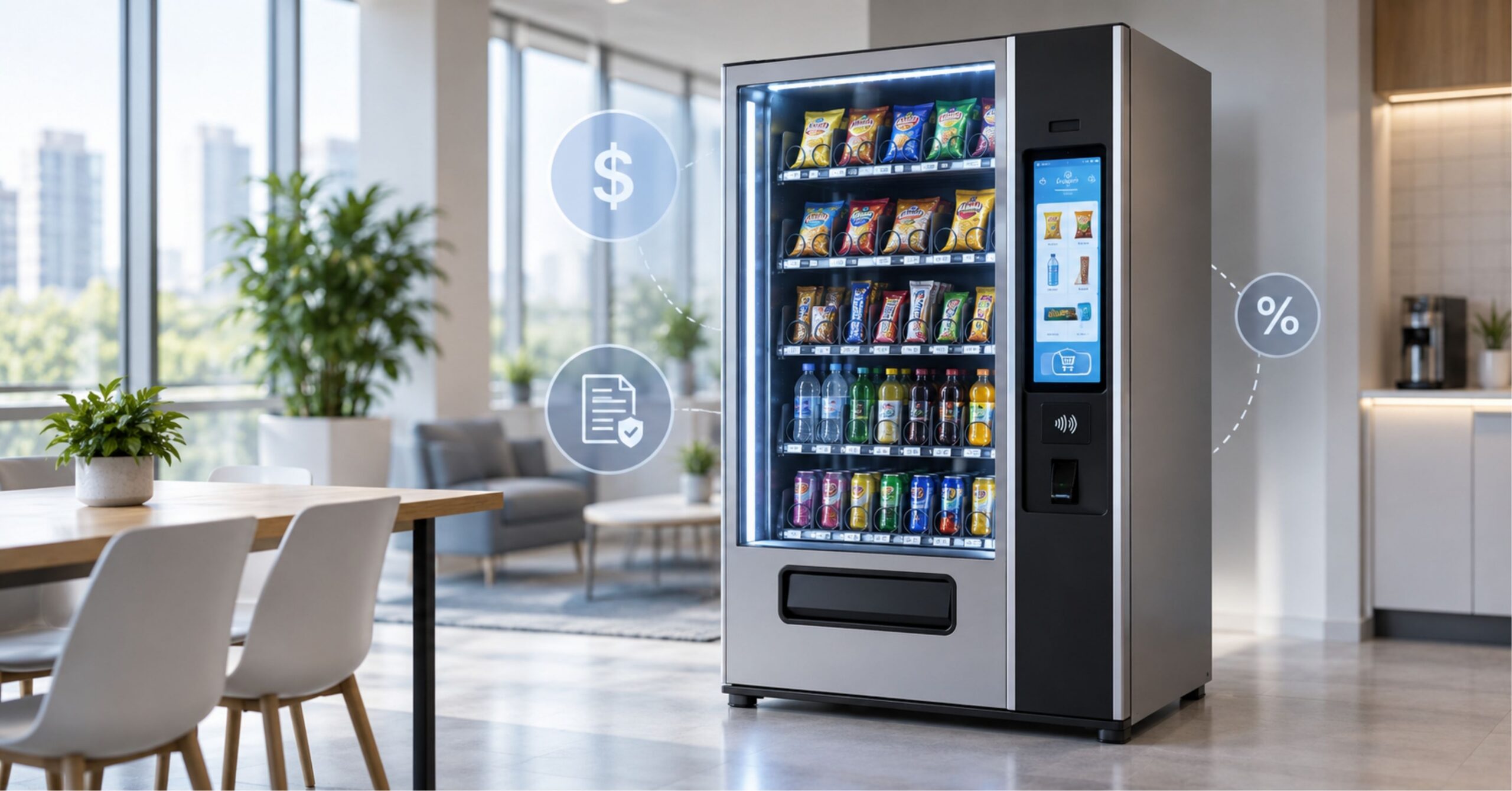
Smart vending machines – the touchscreen, inventory-tracking, cashless-first units you see in office buildings and gyms, start around $5,000 and can go past $10,000 depending on size and features. These make sense once you’re placing machines in locations that expect a modern experience (corporate offices, hospitals, universities) and where the location owner has some say in what goes in their lobby.
A practical note: in California specifically, nearly every location worth having wants cashless payment. Cash-only vending is becoming harder to place, especially in offices and healthcare settings. If you buy a used cash-only machine, budget the extra $200–$500 for a card reader retrofit almost immediately, it’s not really optional anymore.
Licenses and Permits (California-Specific)
This is the part most out-of-state vending guides get wrong, because permit requirements aren’t federal, they’re set at the state and county level, and California has its own particular list.
Seller's Permit
If you’re selling tangible goods, snacks, drinks, anything, you need a Seller’s Permit from the California Department of Tax and Fee Administration (CDTFA). It’s free to obtain, but you’re responsible for collecting and remitting sales tax on every transaction, which matters for your bookkeeping from day one.
Business license
Most California cities and counties require a general business license or business tax certificate, usually in the $50–$200 range depending on your jurisdiction. Some cities also require a separate vending machine permit or decal for each unit, this varies enough by city that it’s worth a direct call to your local business licensing office before you buy anything.
Health permit
If your machines sell food or beverages, your county’s environmental health department will likely require a permit, since vending machines dispensing perishable items fall under food facility regulations in many California counties. Fees and inspection requirements vary by county, so check with your local environmental health department directly, this is one of those things where I’ll figure it out later can actually shut down a placement.
EIN
Free from the IRS, and worth getting even if you’re a sole proprietor, since most location contracts and business bank accounts will ask for one.
None of these individually are expensive. Together, they’re the difference between a hobby and a legitimate business that a property manager will actually sign a placement agreement with.
Insurance
Skipping insurance is one of the more common regrets among new operators. General liability insurance for a small vending operation typically runs $300–$1,200 a year depending on machine count and coverage limits. Many commercial locations, office buildings, schools, hospitals, won’t sign a placement agreement without proof of liability coverage. It’s not a nice-to-have; for a lot of locations, it’s the ticket to even having the conversation.
Inventory
Budget roughly $150–$400 to stock a single machine for its first fill, depending on machine size and product mix. Snack machines are generally cheaper to stock than combo machines carrying both snacks and cold beverages, since drinks have a shorter shelf-stable margin and higher per-unit cost.
The part that catches people off guard isn’t the first fill, it’s the restocking cadence. A slow location might need restocking every two weeks; a high-traffic one might need it twice a week. That’s not a startup cost, but it’s the first thing that turns I bought a machine into I run a business, because now you’re managing a schedule, not just a purchase.
Transportation and Storage
If you already own a car or small SUV, you can start without buying dedicated transportation, most single-machine operators haul inventory in whatever they already drive. Once you’re running multiple machines or a full route, a cargo van becomes worth the investment, whether that’s a used van ($5,000–$15,000) or something newer.
Storage is often free at the start (a garage or spare room works fine for a few machines), but factor in $100–$150/month for a small storage unit once your inventory outgrows your house.
The Cost People Forget: Location Commission
This one isn’t a startup cost, it’s ongoing, and it directly affects your margins. Most location owners want a cut of vending sales in exchange for hosting your machine, typically somewhere between 5% and 25% of gross sales, though some high-traffic or exclusive locations negotiate flat monthly fees instead. This isn’t a fee you pay to start; it’s a fee you pay for every sale, indefinitely, for as long as the machine stays there.
The reason it belongs in a cost conversation is simple: two people can spend the exact same amount starting a vending business and end up with completely different profitability, purely based on the commission terms they negotiated. A location asking for 25% needs meaningfully higher foot traffic to be worth it compared to one asking for 8%.
A Realistic Starting Scenario
To make this concrete, here’s what a modest, single-machine start might actually look like in California:
- New standard snack/drink combo machine: $4,200
- Cashless card reader (included with new purchase in this example): $0 extra
- Business license: $95
- Seller’s Permit: Free
- Health permit: $250
- General liability insurance (annual): $600
- First inventory stock: $300
- Storage: $0 (garage)
Total to open: roughly $5,450
That’s illustrative, not a guarantee, your machine choice, county fees, and insurance quote will move this number up or down. But it shows why the $3,000 to start claims and the $50,000 to start claims can both be true, depending entirely on what you’re building.
How to Lower Your Startup Cost Without Cutting Corners That Matter
Start with one machine, not a fleet
It’s tempting to buy three machines at once to get the route going faster. Most successful operators started with one, learned the restocking rhythm and the location relationship on a small scale, then reinvested profit into machine two and three.
Buy refurbished from a reputable seller, not an unknown private listing
Refurbished machines from vending equipment dealers often come with at least a short warranty and a working service history, which reduces the risk that cheap becomes expensive the first time it breaks down in a location you can’t easily access.
Negotiate commission before you sign, not after
A location that seems perfect at 20% commission might be a much better deal at 10% if you simply ask, many property managers expect some negotiation and haven’t rejected a reasonable counteroffer just for being asked.
Consider a done-for-you setup if your time is worth more than the markup
Some companies handle machine sourcing, placement, and setup for a flat fee. It costs more upfront than doing every step yourself, but it removes a lot of the trial-and-error that eats time and money for first-time operators, worth weighing honestly against your own bandwidth, not just the price tag.
Financing Options If You Don't Have It All Upfront
Most vending machine startups are financed one of three ways:
- Personal savings: the most common path for single-machine starts, since the total is often low enough to self-fund.
- Equipment financing: some vending equipment sellers and third-party lenders offer financing directly on the machine, similar to financing a piece of restaurant equipment, spreading the cost over months rather than paying it all upfront.
- SBA microloans: for those planning a multi-machine operation from the start, SBA microloans (typically up to $50,000) are sometimes used by small vending operators, though approval depends on a business plan and creditworthiness like any other loan.
Common Mistakes That Turn a Good Budget Into a Bad Investment
Buying the machine before securing the location
A great machine sitting in a garage earns nothing. Line up a placement agreement, or at least a strong lead, before you commit to a purchase.
Underestimating the health permit timeline
In some counties, health permit approval isn’t instant. Starting that process early avoids a machine sitting idle while paperwork clears.
Ignoring the commission math
A location with high foot traffic and high commission can still out-earn a low-traffic location with no commission at all. Do the math on expected sales, not just the fee percentage.
Skipping insurance to save a few hundred dollars
It closes doors to the locations most worth having, and a single incident without coverage can cost far more than years of premiums.
How to Know If It's Working: Measuring Profitability
Once you’re operating, the number that matters most isn’t revenue, it’s net profit per machine per month, after restocking cost, commission, and any financing payment. A rough starting benchmark many operators use: a well-placed snack and drink machine in a decent-traffic location can net somewhere in the low hundreds of dollars per month after costs, with high-traffic or multi-machine setups scaling from there. Treat any specific profit number you read, including this one, as a starting estimate to test against your own location’s actual foot traffic, not a promise.
Track it for the first three months. That’s usually enough time to see whether a location’s real performance matches what it looked like when you scouted it.
The Bottom Line
Starting a vending machine business in California isn’t a fixed price, it’s a range that depends on the machine you choose, the location you land, and how many units you’re running on day one. A realistic, no-shortcuts single-machine start lands somewhere around $5,000–$8,000 once permits, insurance, and inventory are counted alongside the machine itself. Go bigger from the start, and the number scales with your ambition.
The businesses that work aren’t necessarily the ones that spent the most, they’re the ones that matched their spending to a real location with real foot traffic, and treated the paperwork as seriously as the machine.
Frequently Asked Questions
It can be, but profitability depends heavily on location foot traffic, commission terms, and how consistently the machine is restocked. A poorly placed machine in a great neighborhood can underperform a modest machine in a high-traffic office lobby.
You'll generally need a Seller's Permit from the CDTFA, a local business license, and — if selling food or beverages — a county health permit. Requirements vary by city and county, so confirm directly with your local licensing office.
Used machines cost less upfront but carry more repair risk and often lack cashless payment. New machines cost more but come with warranties and are easier to place in locations that expect card readers. Many first-time operators split the difference with a refurbished machine from a reputable dealer.
Most locations ask for somewhere between 5% and 25% of gross sales, though some negotiate a flat monthly fee instead. Commission terms are usually negotiable before you sign a placement agreement.
Yes — many operators intentionally start with a single machine to learn the restocking rhythm and location relationship before reinvesting profit into additional machines.