Vending Machine Cleaning & Hygiene Standards Every Business Should Expect
Yes, vending machines in California are legally required to meet specific sanitation standards under the California Retail Food Code, and depending on what they sell, they may also need a county health permit. For any business hosting a machine- an office break room, a gym, a school, a medical office- that’s the baseline. But compliant and actually clean aren’t always the same thing, and most of the complaints businesses get about vending machines have nothing to do with a missing permit and everything to do with a sticky keypad or a machine nobody has serviced in weeks.
This guide breaks down what California law actually requires, what enforcement looks like at the county level, and what a genuinely hygienic vending setup involves day to day, so you know what to expect from a vendor and what to check if something feels off.
What Counts as a Hygienic Vending Machine?
A hygienic vending machine is one that keeps food and beverages protected from contamination from the moment they’re loaded to the moment a customer takes them out, and that can prove it through consistent cleaning practice and, where required, proper permitting. That covers several layers: the condition of the product itself, the surfaces customers touch, the compartment the food sits in, and the floor and location the machine occupies.
California law specifically requires that the floor area where a vending machine sits be smooth, of cleanable construction, and able to withstand repeated washing and scrubbing, and any water used inside the machine must be potable. Hygiene, in other words, isn’t just about wiping down the outside panel; it’s a system that starts with where the machine is placed and extends to how it’s stocked, cleaned, and monitored.
California's Legal Framework for Vending Machine Hygiene
Vending machine sanitation in California falls under the California Retail Food Code (CRFC), part of the state’s Health and Safety Code. The core hygiene rules sit in Section 114145 and the surrounding Article 10 provisions. Several requirements apply directly to day-to-day cleanliness:
- Wet storage of prepackaged products is prohibited; packaged snacks and drinks can’t sit in standing water or condensation inside the machine.
- Potentially hazardous food must be dispensed to the consumer in the original package it was placed in at the commissary or food processing plant, and bulk potentially hazardous food is prohibited.
- Single-use articles used in bulk-dispensing machines must be obtained in sanitary packages and stored in that original packaging until they’re loaded into the machine.
- Operators must maintain a cleaning and sanitizing record for each machine, and that record has to stay current for at least the past 30 days.
- If a machine sits outdoors without another form of weather protection, or is accessible for self-service when no employee is supervising it, its dispensing compartment must have a self-closing door or cover to keep out rain, debris, insects, and rodents.
- While food, containers, and equipment are in transit to a machine’s location, they must be protected from dirt, vermin, and other contamination, meaning hygiene requirements start before the van even reaches your building.
These aren’t optional best practices. They’re statutory requirements, and a county inspector can act on them the same way they would for a restaurant kitchen.
Do Vending Machines Need a Health Permit in California?
It depends on what the machine sells. Machines that sell only sealed, shelf-stable snacks and bottled or canned beverages generally don’t need a health permit, because there’s no food preparation or temperature control involved. Health permits become necessary when a vending machine dispenses regulated food, fresh meals, refrigerated items, frozen products, hot food, or prepared beverages such as brewed coffee, since those involve water supply, sanitation, and temperature control.
This split shows up consistently at the county level. Orange County’s Health Care Agency requires a health permit for vending machines dispensing items like coffee, sandwiches, ice cream, and dairy products, and requires operators to keep a current list of vending machine locations on file. Some cities go further on documentation: San Francisco requires food vending machine operators to obtain a decal for each machine from the Health Department and to submit quarterly inspection reports along with a current count of machines in operation, and a machine found to be unsanitary, malfunctioning, or missing its required decal can be sealed by a health inspector until it’s brought back into compliance.
For most California workplaces stocking snacks and cold drinks, the practical takeaway is simple: packaged vending is the lower-friction, lower-risk path, and it’s why most office, gym, and school vending programs stick to that category rather than fresh or hot food.
Who Enforces These Rules?
Enforcement happens at the county level, not through a single statewide vending inspector. In Los Angeles County, the Department of Public Health’s Environmental Health division enforces the state Health and Safety Code for vending machines everywhere in the county except Long Beach, Pasadena, and Vernon, which run their own environmental health departments. Every California county follows a similar pattern: a county (or in some cases city) environmental health division handles permitting, inspections, and complaint response for food vending within its jurisdiction. If employees or customers ever want to report a problem with a machine, that county or city environmental health office not the state, is the right contact.
The Cleaning and Sanitizing Log Requirement
Every vending machine covered by the CRFC needs a documented, up-to-date cleaning and sanitizing record. Operators are required to maintain that record for each machine and keep it current for at least the past 30 days. In practice, this means a vending operator should be able to show, on request, when a specific machine was last cleaned and sanitized, not just claim that it happens.
For a business hosting the machine, this is one of the easiest compliance checks available: ask your vendor whether they maintain a sanitizing log per machine, and don’t accept a vague answer. A vendor with a real routine will have this information ready without hesitation.
Why High-Touch Surfaces Deserve Extra Attention
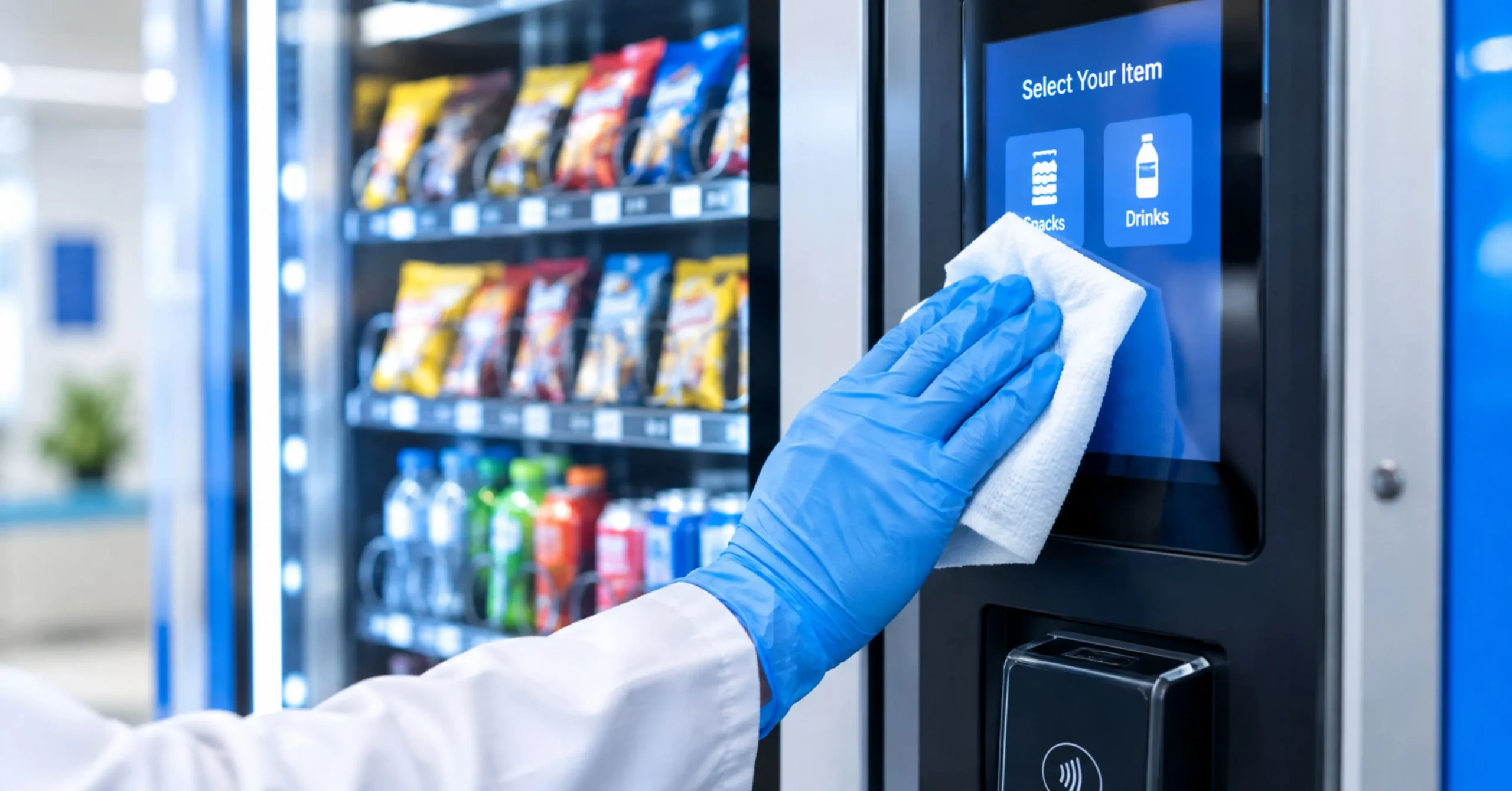
The law focuses heavily on the food and the storage environment, but the surfaces customers actually touch, buttons, keypads, and touchscreens- aren’t specifically addressed in the same detail, even though independent research suggests they’re a real hygiene gap. A microbiology study of public vending machine buttons and touchscreens isolated several bacterial species from tested machine surfaces, with Staphylococcus aureus present on 67% of machines sampled, and the researchers concluded that vending machine buttons and touchscreens act as vehicles for potential pathogens with a meaningful impact on community health, and recommended improved sanitization of those surfaces.
A separate study of touchscreen-based parcel vending machines reached a similar conclusion, noting that the findings point to a need for regular disinfection procedures or modified surface materials to reduce how easily bacteria adhere to vending machine touchscreens. Neither of these studies was conducted in California, and they shouldn’t be read as a claim about any specific machine or vendor, but they’re a useful reminder that legal compliance and a genuinely low-risk touch surface aren’t automatically the same thing. Wiping down keypads and screens, not just the machine’s exterior panel, is a detail worth confirming with any vendor.
A Practical Hygiene Checklist for Businesses Hosting a Machine
Before approving or renewing a vending contract, it’s reasonable to ask a vendor to confirm the following:
- A current, per-machine cleaning and sanitizing log going back at least 30 days
- A regular restocking schedule that prevents expired or near-expired products from sitting in the machine
- Visible attention to high-touch surfaces – buttons, touchscreens, and coin/card readers – not just the cabinet exterior
- No wet storage of packaged products and no condensation pooling inside the dispensing area
- The correct permit type on file if the machine sells anything perishable, refrigerated, hot, or freshly brewed
- A weatherproof, self-closing dispensing door if the machine is outdoors or unsupervised
- A placement location with a smooth, cleanable floor surface underneath and around the machine
- A clear point of contact for reporting an issue, with a realistic response time
If a vendor can’t answer these questions specifically, that’s worth treating as a signal, regardless of how the machine looks on the outside.
Common Hygiene Mistakes (and What They Lead To)
No cleaning log, or one that isn't current
This usually happens when a vendor treats cleaning as something done when someone gets around to it, rather than on a schedule. The consequence is straightforward: if a county inspector requests records, there’s nothing current to show, which is itself a violation independent of whether the machine looks clean. The fix is a fixed cleaning cadence tied to restocking visits, with the record updated every time.
Wet storage of packaged snacks or drinks
Condensation or standing water inside a machine, often from a refrigeration issue or a leaking line, can degrade packaging and create a contamination risk. It happens when refrigerated units aren’t serviced regularly. The fix is routine equipment checks as part of every visit, not just when a customer complains.
Selling perishable or hot food without the matching permit
This typically happens when a business adds a coffee or fresh-food machine without realizing the permit requirements are different from a snack machine. The consequence can range from a compliance notice to a sealed machine. The fix is confirming permit status in writing before any perishable or hot-beverage machine goes in.
Ignoring the touchscreen or keypad during cleaning visits
Because these aren’t food-contact surfaces in the strict legal sense, they’re easy to overlook during a quick restock. Given what the touchscreen studies above found, this is a gap worth closing even though it isn’t spelled out line-by-line in the Health and Safety Code.
What to Look For in a Vending Provider
A hygienic vending program is really a service quality question as much as a legal one. Businesses evaluating a vendor in California should look for:
- Documented, per-machine cleaning records rather than a general we clean regularly assurance
- A restocking cadence frequent enough to prevent stale or expired inventory
- Clear ownership of maintenance, so hygiene issues (leaks, jams, sticky buttons) get fixed quickly rather than sitting for weeks
- Correct permitting for whatever the machine actually sells
- A local team that can respond to an on-site issue without a long delay
This is the standard a fully managed vending service is built around: Agape Vending Machines handles installation, restocking, cleaning, and maintenance for offices, gyms, schools, and healthcare facilities across Palm Desert and the Coachella Valley at no cost to the host business, so hygiene upkeep doesn’t fall on your own staff. If your break room machine has been serviced inconsistently, or you’re weighing a snack, drink, or smart vending machine for the first time, it’s worth asking any prospective vendor the checklist questions above before you sign.
Frequently Asked Questions
California law doesn't set one universal cleaning frequency for every machine type — it requires that a cleaning and sanitizing record be kept current for at least the past 30 days. In practice, most well-run vending programs clean high-touch surfaces at every restocking visit and do a deeper sanitation pass on a fixed schedule, since restocking visits are already frequent enough to catch most issues early.
Yes, but with a condition. If a machine sits outdoors without other weather protection, or is accessible for self-service outside of employee supervision, its dispensing compartment needs a self-closing door or cover to keep out rain, debris, insects, and rodents.
No. Machines selling only sealed, shelf-stable snacks and bottled or canned drinks generally don't require one. Permits become necessary for machines dispensing perishable, refrigerated, frozen, hot, or freshly brewed items, because those involve temperature control or preparation.
Your county (or in some cities, city-level) environmental health department handles vending machine complaints and inspections. Los Angeles County, for example, routes these through its Department of Public Health Environmental Health division, and most other California counties follow a similar structure.
Independent research on public vending machines has found bacterial contamination, including Staphylococcus aureus, on button and touchscreen surfaces at meaningful rates. This isn't a California-specific finding and doesn't indicate anything about a particular machine, but it supports treating keypads and screens as part of a machine's cleaning routine rather than an afterthought.
The Bottom Line
California’s vending machine hygiene rules cover more than most people expect – cleaning records, permit categories, weatherproofing, and floor standards are all written into law, and they’re enforced county by county rather than through a single statewide inspector. Meeting the legal minimum is the starting point; a genuinely clean, well-run machine also means attention to the surfaces people actually touch and a vendor who can show their work, not just claim it. If you’re responsible for a vending machine at your workplace, the fastest way to know where you stand is to ask your provider for their cleaning log and permit documentation directly, and if you don’t have a reliable answer, reach out to Agape Vending Machines for a fully managed setup that keeps that documentation current for you.