
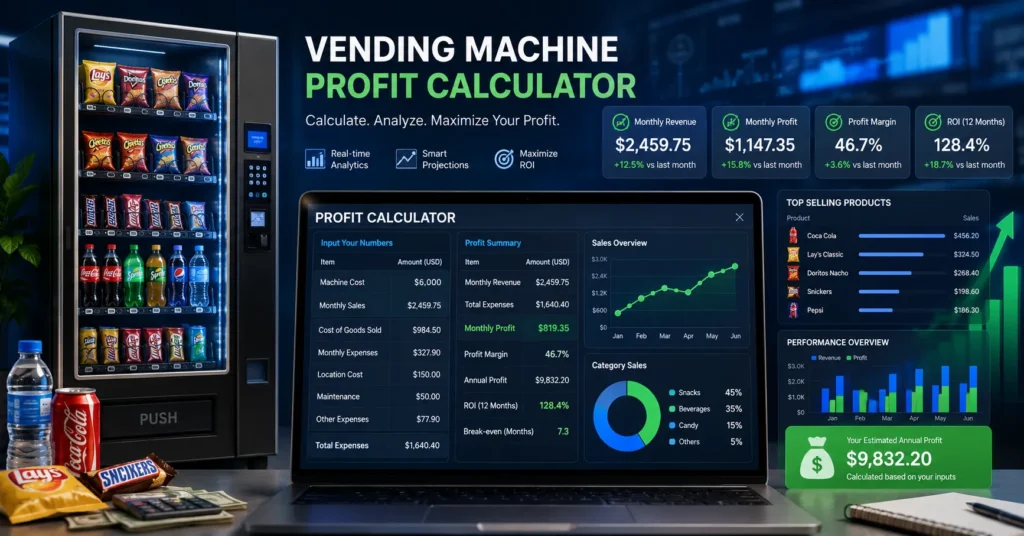
So you’re thinking about starting a vending machine business, or maybe you already have a few machines running and want to know if the numbers actually make sense.
Either way, using a vending machine profit calculator is the smartest first step before you spend a single dollar. It gives you a realistic picture of your monthly income, operating costs, and return on investment, without the guesswork.
In this guide, we’ll break down exactly how vending machine profit is calculated, what expenses to expect, and how to estimate real earnings based on your location, machine type, and product mix. Whether you’re in Los Angeles, San Diego, Fresno, or anywhere else in California, these numbers apply directly to you.
What Is a Vending Machine Profit Calculator?
A vending machine profit calculator is a tool that helps you estimate how much money a vending machine can make after subtracting all operating expenses from total sales revenue.
Your vending machine profit = Total Revenue − (Cost of Goods + Commission + Maintenance + Electricity + Other Expenses)
It sounds simple. But there are more variables than most people expect, and that’s exactly why so many new vending operators underestimate their costs or overestimate their earnings.
How Much Does a Vending Machine Make Per Month?
This is the question everyone asks first. And the honest answer: it depends.
Here’s a realistic range based on location and foot traffic:
Location Type | Avg. Daily Sales | Avg. Monthly Revenue | Est. Monthly Profit |
Low-traffic office (under 30 people) | $10–$20 | $300–$600 | $80–$180 |
Medium office or gym | $30–$60 | $900–$1,800 | $280–$600 |
School campus or hospital | $60–$120 | $1,800–$3,600 | $600–$1,200 |
High-traffic transit or mall | $100–$200+ | $3,000–$6,000+ | $1,000–$2,200+ |
These numbers assume a standard snack or beverage vending machine with a card reader, stocked with popular products.
The Vending Machine Profit Formula (Step-by-Step)
Let’s walk through this like a real operator would.
Step 1: Estimate Your Monthly Revenue
Start with your expected daily transactions and average sale price.
Formula: Monthly Revenue = Daily Transactions × Average Sale Price × 30
Example:
- A snack vending machine in a gym sees 25 transactions per day
- Average item price: $2.00
- Monthly Revenue = 25 × $2.00 × 30 = $1,500
Step 2: Subtract Cost of Goods Sold (COGS)
Your product cost is typically 25%–40% of your selling price, depending on what you stock.
- Chips, candy, granola bars: ~$0.50–$0.80 per item
- Beverages (soda, water, energy drinks): ~$0.60–$1.20 per item
Example: 40% COGS on $1,500 = $600 in product costs
Step 3: Subtract Location Commission
Most location owners, whether it’s an office building, gym, or school campus, charge a commission between 5% and 25% of gross sales.
Example: 15% commission on $1,500 = $225
Step 4: Subtract Operating Expenses
Here’s what most calculators leave out:
- Electricity: $15–$30/month per machine
- Machine maintenance/repairs: $20–$50/month average
- Credit card processing fees: 2.5%–3.5% of card sales
- Fuel/mileage for restocking: $30–$80/month depending on distance
- Business insurance: ~$30–$50/month (amortized)
Estimated total monthly operating costs: $95–$210
Step 5: Calculate Net Profit
Net Monthly Profit = Revenue − COGS − Commission − Operating Costs
Using our example: $1,500 − $600 − $225 − $150 = $525/month net profit
Not bad for a single machine. Scale to 5 machines in good locations and you’re looking at $2,500+/month in passive income.
Vending Machine ROI: When Will You Break Even?
ROI is everything in the vending machine business. Here’s how to calculate it.
Break-Even Formula: Break-Even Point = Total Startup Cost ÷ Monthly Net Profit
Typical Startup Costs
Expense | Cost Range |
New snack vending machine | $3,000–$5,000 |
New beverage vending machine | $3,500–$6,000 |
Used/refurbished machine | $1,200–$2,500 |
Initial inventory | $200–$500 |
Card reader/cashless system | $100–$300 (or leased) |
Location setup/permits | $0–$200 |
Total (new machine) | $3,500–$6,000 |
Example:
- Machine cost: $4,000
- Monthly net profit: $525
- Break-even: $4,000 ÷ $525 = ~7.6 months
That’s under 8 months to full ROI on a single machine in a decent location. A Coca-Cola vending machine or a premium snack vending machine in a hospital or transit hub could hit break-even even faster.
What Kills Vending Machine Profit (And How to Avoid It)
Most operators who struggle with profitability make the same mistakes. Here are the biggest profit killers and how to fix them.
1. Bad Location Choice
Foot traffic is everything. A machine placed in a low-traffic hallway with 15 employees will never perform like one near a gym entrance or busy break room.
Fix: Always visit the location in person. Count people. Ask the location owner about daily foot traffic before signing any agreement.
2. Overpaying on Commission
Some locations try to charge 25–30% commission. That eats your margin fast.
Fix: Negotiate. Most fair agreements fall between 10–15%. In high-value locations like hospitals or airports, 20% is acceptable because the volume makes up for it.
3. Ignoring Shrinkage and Spoilage
Chips go stale. Energy drinks expire. Poor inventory rotation wastes money.
Fix: Track inventory every restock visit. Use a simple spreadsheet or vending management software. Rotate stock properly, first in, first out.
4. Skipping Cashless Payment
In California especially, fewer people carry cash. A machine without a card reader will lose 30–40% of potential sales.
Fix: Install a cashless card reader. The processing fees (2.5–3%) are far less than the sales you’d lose.
5. Not Adjusting Your Product Mix
Every location has different buying habits. A gym needs protein bars and water. An office wants coffee and snacks. A school campus sells chips and juice.
Fix: Review your sales data every 30–60 days and swap out slow-moving items for proven sellers.
Snack vs. Beverage Vending Machine: Which Is More Profitable?
Both can be profitable, but they have different margin profiles.
Factor | Snack Machine | Beverage Machine |
Average product cost | 30–40% of sale price | 35–50% of sale price |
Average sale price | $1.50–$3.00 | $1.75–$3.50 |
Restocking frequency | Every 1–2 weeks | Every 1–2 weeks |
Electricity usage | Low | Higher (refrigeration) |
Machine cost (new) | $3,000–$5,000 | $3,500–$6,000 |
Offices, schools, gyms | Gyms, transit, hospitals |
Bottom line: Snack machines often have slightly better margins. Beverage machines can generate higher volume in the right locations. A combo machine (snacks + drinks) is often the best single-machine investment for most operators.
How Location Profitability Affects Your Vending Machine Business
Not all locations are equal. Here’s a quick breakdown of what you can realistically expect by location type in California:
Office Buildings
- Consistent, predictable traffic
- Lower volume but reliable daily sales
- Commission: 10–15%
- Best for: operators just starting out
Gyms and Fitness Centers
- Health-conscious buyers willing to spend more
- High demand for protein snacks, water, sports drinks
- Commission: 15–20%
- Best for: premium product pricing
School Campuses
- High volume during school hours
- Requires compliance with California nutritional guidelines
- Commission: varies
- Best for: high-turnover, affordable snacks
Hospitals and Medical Centers
- 24/7 foot traffic
- Staff, visitors, and patients are all buyers
- Higher competition for placement
- Best for: experienced operators ready to scale
Convenience Store Alternatives
- Standalone kiosk-style setups
- Growing opportunity in California with rising demand for quick-access items
- Best for: operators with multiple machines
Key Takeaways
- A single vending machine in a good California location can net $300–$1,200/month after expenses
- Your biggest cost variables are COGS, commission, and location quality
- ROI on a new machine typically falls between 6–12 months depending on placement
- Cashless payment is non-negotiable in California — card readers increase sales significantly
- The best locations for vending machine profitability are gyms, hospitals, schools, and busy office buildings
- Use the profit formula: Revenue − COGS − Commission − Operating Costs = Net Profit
Frequently Asked Questions
A vending machine in an average California location generates between $300 and $1,200 in monthly net profit after expenses. High-traffic locations like hospitals or transit hubs can earn $1,500–$2,500+ per machine monthly.
Divide your total startup cost by your monthly net profit. For example, a $4,000 machine earning $500/month net reaches full ROI in about 8 months.
A healthy vending machine profit margin is 20–35% of gross revenue after all expenses. Margins below 15% usually signal a location or commission problem.
The main costs are: product inventory (COGS), location commission, electricity, maintenance and repairs, card processing fees, and transportation for restocking.
Yes especially once machines are placed and running. Most operators spend 1–3 hours per machine per week on restocking and maintenance. With 5–10 machines, this becomes a meaningful part-time or full-time passive income stream.
Starting with one machine typically costs $1,500–$6,000 depending on whether you buy new or used. Add initial inventory ($200–$500) and any permits or location setup costs. Total startup investment: roughly $2,000–$7,000 for your first machine.
Ready to Start Your Vending Machine Business in California?
At Agape Vending Machines, we help California entrepreneurs place profitable machines in high-traffic locations, without the hassle of finding spots yourself.
Whether you’re looking to start with one machine or build a full vending route, we handle the placement, setup, and ongoing support so you can focus on the income.
Get a Free Profit Estimate for Your Location. Tell us where you want to place a machine, and we’ll run the numbers for you.