Smart vending machines vs. traditional: which is better in 2026
Choosing the right vending machine can affect your daily work, customer experience, and profit. Many businesses still use traditional machines, but smart vending machines are growing fast.
Today, vending machines are changing with new technology. Smart machines now use the internet, sensors, and cashless payments to improve efficiency and sales.
If you run an office, warehouse, gym, or commercial space, this decision is not just about snacks. It’s about saving time, reducing costs, and improving operations.
In this guide, you’ll learn the real difference and which option is best for your business.
What is the difference between smart and traditional vending machines?
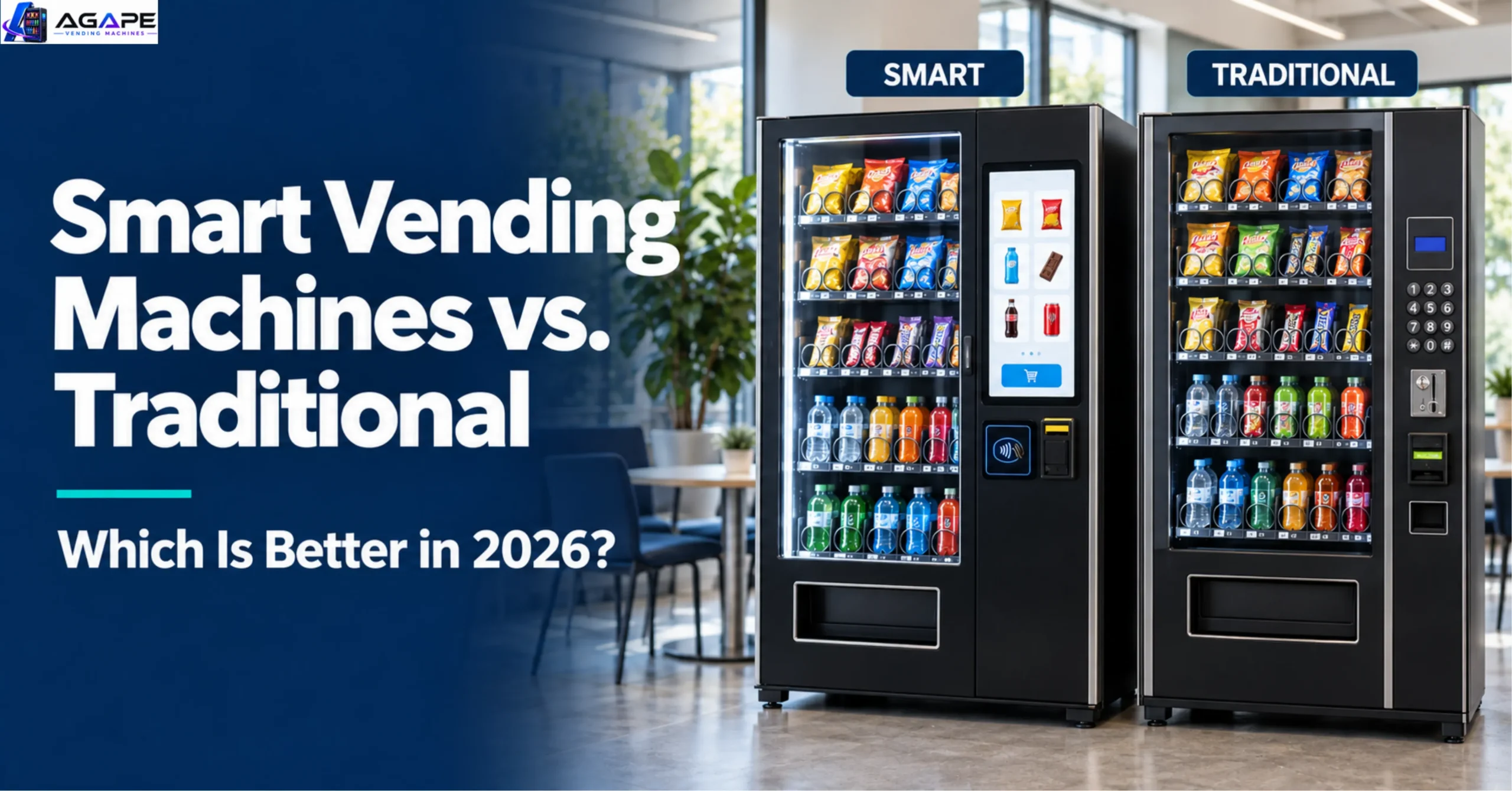
Traditional vending machines take cash and need people to refill them by hand. They do not track sales or stock. Smart vending machines use the internet and allow card or phone payments. They track sales and stock and can be checked from anywhere.
Quick Comparison: Smart vs Traditional Vending Machines
Feature | Traditional Vending Machine | Smart Vending Machine |
Payment | Cash only | Card, mobile, cashless |
Inventory | Manual checking | |
Restocking | Fixed schedule | Based on demand |
Maintenance | After problems happen | Alerts before issues |
Data | No tracking | Live data and reports |
User Experience | Basic buttons | Touchscreen or grab-and-go |
Management | On-site only | Remote access |
Efficiency | Time-consuming | Automated |
What Is a Traditional Vending Machine?
A traditional vending machine is a mechanical, standalone unit. It accepts coins and bills, turns a spiral coil, and drops a product into a bin. That’s it. No Wi-Fi. No reporting. No memory of what was sold.
For decades, operators loved the simplicity. But that simplicity hides three brutal inefficiencies.
How Traditional Machines Actually Work?
Inside a standard traditional machine:
- A coin mechanism validates currency using magnetic and size sensors.
- A bill acceptor pulls in paper money and jams frequently.
- A control board sends power to a motor when the correct amount is entered.
- The motor rotates a spiral coil, pushing the product forward until it falls.
The critical flaw: The machine assumes the product dropped. It has no way to verify. If the item gets stuck on the coil, the customer loses money, and the operator never knows until someone complains.
The Real Cost of Simple
Traditional machines feel cheaper upfront. A refurbished unit might cost $1,500 to $3,000. But here’s what the price tag doesn’t show:
- Labour for route checks: Someone must physically visit every machine weekly, open the door, and count remaining items.
- Lost sales from stockouts: When the machine sells out of your top product on Tuesday, it sits empty until Thursday’s visit.
- Cash handling hell: Collecting, counting, rolling, and depositing coins eats hours each week.
One vending operator I spoke with tracked his team’s time. Forty-three per cent of every shift was spent checking machines that didn’t need restocking. That’s nearly half his payroll burned on guesswork.
What Is a Smart Vending Machine?
A smart vending machine is an internet-connected, sensor-packed retail system. It reports every transaction, every temperature change, and every potential malfunction directly to your phone or computer.
In 2026, smart isn’t just a touchscreen. It’s a complete ecosystem.
Core Technologies Inside Smart Machines
Technology | What It Does | Why It Matters |
IoT Telemetry | Sends real-time data via 4G/5G or Wi-Fi | You see inventory levels from anywhere |
Weight Sensors | Measures gram-level changes on each shelf | Enables true grab and go- no buttons needed |
Cashless Payment | Accepts cards, mobile wallets, and RFID badges | Faster transactions, less theft, no coin counting |
Remote Diagnostics | Monitors motor torque, compressor health | Alerts you before the machine breaks |
Dynamic Display | Touchscreen that changes pricing and ads instantly | Test promotions without visiting the site |
The Grab and Go Breakthrough
The most advanced smart machines use load cells under each shelf. Remove a Red Bull? The system detects the weight loss instantly and charges the customer. Take a sandwich and a salad? It charges for both. No coils. No buttons. No waiting.
This technology, common in Amazon Go stores, is now available in smart vending machines for under $8,000.
Key Benefits of Smart Vending Machines in 2026
Let’s put them side by side using real operational data.
Connectivity and Data
Traditional: Zero connectivity. You have no idea what’s happening inside until you open the door.Smart: Full IoT connection. You can check stock levels, sales by hour, and machine temperature from your phone while eating breakfast.
Winner: Smart, by a massive margin.
Payment Options
Traditional: Cash only. Maybe an aftermarket card reader that fails often and skims fees.Smart: Cash, credit/debit cards, Apple Pay, Google Pay, QR codes, employee RFID badges, and even facial recognition on premium models.
Winner: Smart cash is dying. In 2026, over 60% of vending transactions are cashless in urban areas.
Maintenance and Repairs
Traditional: Reactive. The machine breaks. A customer calls the number on the front. You dispatch a technician to diagnose. He doesn’t have the part. He returns next week.Smart: Proactive. The machine detects a failing cooling fan. It sends a service-needed-soon alert. You order the part and send a technician once, with the correct component in hand.
Winner: Smart downtime drops by 70% in real-world fleets.
Restocking Efficiency
Traditional: Fixed route schedule. You visit every machine every week, whether it needs 50 items or 5. You count inventory by hand, then walk back to the truck to grab products.
Smart: Dynamic dispatch. Your dashboard shows exactly which machines need which items. You pre-pack totes for each location. Drivers only visit machines below the threshold.
Winner: Smart labour costs for restocking can drop by 60%.
Upfront Investment
Traditional: $2,000 to $4,000 for a new machine. $1,500 for refurbished.
Smart: $5,000 to $12,000 depending on features, touchscreen, weight sensors, and cashless.
Winner: Traditional, but only on day one. We’ll calculate ROI next.
Cost & ROI Comparison
Let’s run the numbers for a small operator with 10 machines.
Traditional Vending Fleet (10 machines)
Expense | Monthly Cost |
Labour (20 hours/week checking + restocking @ $25/hr) | $2,000 |
Cash handling (bank fees, counting time) | $300 |
Lost sales from stockouts (estimated 8% of revenue) | $400 |
Repair costs (reactive service calls, emergency trips) | $500 |
Total monthly operating cost | $3,200 |
Smart Vending Fleet (10 machines)
Expense | Monthly Cost |
Labour (8 hours/week dynamic restocking @ $25/hr) | $800 |
Cash handling (90% cashless – minimal fees) | $50 |
Lost sales from stockouts (real-time alerts reduced to 1%) | $50 |
Repair costs (proactive – fewer emergency calls) | $200 |
IoT connectivity fees ($15/machine/month) | $150 |
Total monthly operating cost | $1,250 |
Monthly savings with smart vending: $1,950
Annual savings: $23,400
Even if you pay an extra $5,000 per machine upfront, your payback period is roughly 2.5 machines per year. For a 10-machine fleet, the switch pays for itself in under 12 months.
The Decision Matrix: Which Machine for Your Situation?
Not every location needs a smart machine. Use this framework to decide.
Choose Traditional Vending If:
- Your location gets fewer than 10 transactions per day.
- You only sell low-value items ($1–$2 snacks).
- The site has no reliable internet or cellular signal.
- Your budget is under $3,000 total and cannot flex.
- You’re testing a brand new, unproven location.
Example: A small auto repair shop waiting room. Five mechanics buy a soda each day. A $1,500 refurbished traditional machine is fine.
Choose Smart Vending If:
- Your location gets 25+ transactions per day.
- You sell higher-value items, $5–$50 tools, electronics, and PPE.
- Employee theft or shrinkage is a concern smart lockers solve this.
- You want to offer subsidised items, free coffee, and discounted snacks for staff.
- You have multiple machines and want centralised management.
Example: A 200-person office. Employees expect contactless payment, dietary options, and 24/7 availability. A smart machine with RFID badges and weight sensors pays for itself in six months.
The Hybrid Approach
Many successful operators use traditional machines in low-traffic back offices and smart machines in high-traffic breakrooms, gyms, and public spaces. This gives you the low upfront cost where it matters and the data benefits where volume justifies it.
Real Case Study: How One Factory Saved $18,000 Yearly
A Midwest manufacturing plant had three traditional vending machines selling PPE gloves, safety glasses, and earplugs. The problems:
- Machines constantly ran out of popular sizes.
- Workers took extra items, just in case, with shrinkage at 22%.
- The maintenance supervisor spent 4 hours weekly checking and restocking.
They switched to one smart locker system, a type of smart vending machine with individual compartments. Results after 12 months:
- Shrinkage dropped to 3%. RFID tracking held employees accountable.
- Labour for restocking fell from 4 hours to 45 minutes per week.
- Stockouts eliminated real-time alerts that triggered refills.
- Total annual savings: $18,400.
The smart locker costs $9,500 installed. Payback period: 6.2 months.
Potential Downsides of Smart Vending
Any article claiming smart vending is perfect is not being honest. Here are legitimate challenges to consider.
1. Higher Upfront Cost
A fully loaded smart machine with weight sensors, a touchscreen, and cashless payment runs $8,000–$12,000. That’s 3x a basic traditional unit. If you’re cash-strapped, this is a real barrier.
Mitigation: Lease the machine or buy refurbished smart units, saving 30–40%.
2. Connectivity Dependency
No internet, no real-time data. While most machines queue transactions and sync later, offline periods create blind spots.
Mitigation: Choose machines with built-in 4G LTE cellular. They don’t rely on the location’s Wi-Fi.
3. Integration Complexity
Connecting your vending data to accounting or ERP systems requires technical setup. Small operators often ignore this and lose some benefit.
Mitigation: Start with the manufacturer’s dashboard. Integrate later when you have 5+ machines.
4. Employee Resistance
Some workers feel watched when using RFID badges or facial recognition. Privacy concerns are real.
Mitigation: Be transparent. Explain that tracking is for inventory accuracy, not individual performance. Offer subsidised items to build goodwill.
2026 Trends That Favour Smart Vending
The debate is shifting fast. Here’s what’s changing right now.
Cashless is Becoming Expected
In 2026, Gen Z and Millennials carry physical cash less than 10% of the time. A traditional cash-only machine instantly loses 40% of potential sales.
Dynamic Pricing is Powerful
Smart vending screens let you change prices remotely. Run a happy hour discount from 2–4 PM. Test a 10% markup on hot days for cold drinks. You can’t do any of this with a static traditional machine.
Sustainability Tracking
Corporate ESG Environmental, Social, Governance goals now include supply chain visibility. Smart machines track expiration dates and reduce food waste by alerting operators before items spoil. Traditional machines? Food sits until someone notices.
Integration with Employee Perks
Companies want to offer free daily snacks or monthly credits. Smart machines with RFID badges make this seamless. Employees scan, select, pay $0, and the machine deducts from their allowance. Traditional machines can’t handle this at all.
Actionable Steps to Make Your Choice Today
Ready to decide? Follow this 5-step process.
Step 1: Count Your Daily Transactions
Spend one week tracking how many items sell per day. Under 15? Traditional might work. Over 25? Go smart.
Step 2: Calculate Your Labour Cost
How many hours per week does someone spend checking, restocking, and fixing vending machines? Multiply by $25–$35/hour. That’s your hidden labour waste.
Step 3: Assess Your Products
Are you selling $1 candy bars or $50 power tools? High-value items need smart lockers with accountability. Low-value? Traditional is fine.
Step 4: Check Connectivity
Does your location have a reliable cellular (4G/5G) signal? Yes? Smart is viable. No? Traditional may be your only option.
Step 5: Run a 90-Day Pilot
Don’t convert your whole fleet. Buy or lease one smart machine for your highest-traffic location. Compare sales, labour, and stockout rates to your traditional machines. Let the data decide.
Frequently Asked Questions About Smart vs Traditional Vending Machines
Yes, you can use IoT telemetry retrofit kits that cost $300 to $600. They add remote tracking and alerts, but do not include touchscreen or full cashless features.
Smart vending machines typically last 8 to 12 years. Some electronic parts like payment systems or screens may need replacement after 5 to 6 years.
Most smart machines store transactions offline and sync later. Cash payments still work, but real-time reporting and some cashless features may pause.
No, they are similar. Mechanical parts are the same, and electronic components are modular and can be replaced quickly, often within minutes.
No, most providers use standard payment processors that deposit funds into a regular business bank account within 2 to 3 days.
What Should You Choose in 2026?
Here’s the truth.
If you have one machine in a low-traffic location with a tight budget, a traditional vending machine still works. It’s not optimal, but it’s functional.
For everyone else, especially operators with 3+ machines, high-traffic locations, or valuable inventory, smart vending is the clear winner. The labour savings alone typically cover the higher upfront cost within 12–18 months. Add in reduced stockouts, cashless convenience, and real-time data, and the decision becomes obvious.
The traditional vending vs smart vending machine debate in 2026 isn’t really a debate anymore. It’s a math problem. Run the numbers for your specific situation. But don’t ignore the hidden costs of simplicity; they’re stealing from your bottom line every single day.
Your next step: Identify your single busiest location. Rent or buy one smart vending machine. Track every dollar and every minute for 90 days. Compared to your traditional machines. Then decide.
The data will set you free.