Vending Machine ADA Compliance in California: What Every Operator Needs to Know
Picture a modern vending machine inside a busy California office. It has a glass front, bright LED lighting, cashless payment, and dozens of products. At first glance, it appears to be a perfect addition to the workplace.
But there is a problem: the payment terminal is positioned too high for a wheelchair user to reach comfortably. A recycling bin also blocks part of the floor space in front of the machine. Although the machine looks modern, it may not provide an accessible purchasing experience for everyone.
That is the challenge with vending machine ADA compliance. Accessibility problems are rarely caused by bad intentions. More often, businesses purchase or install equipment without evaluating how a person with a disability will approach, operate, pay, and retrieve a product from the machine.
If you own, lease, service, or host vending machines in California, accessibility should be considered during machine selection, installation, and routine maintenance. This guide explains the relevant federal standards, California-specific considerations, smart-vending accessibility concerns, and a practical checklist you can use to evaluate your machines.
What Vending Machine ADA Compliance Actually Means
The phrase ADA-compliant vending machine is frequently used on manufacturer websites and equipment specification sheets. However, accessibility involves more than purchasing a machine advertised as ADA-compliant.
Title III of the Americans with Disabilities Act requires businesses open to the public, known as places of public accommodation, to provide people with disabilities full and equal access to their goods, services, facilities, privileges, and accommodations.
A vending machine is not itself generally classified as a place of public accommodation. The business or facility where the machine is located may be covered by the ADA.
The federal ADA Standards for Accessible Design primarily apply to fixed or built-in elements. Movable equipment and furnishings are not always covered by the same technical construction standards. Nevertheless, a business may still have broader obligations to make its products and services accessible.
Accessibility may involve:
- An accessible route to the vending area
- Sufficient clear floor space
- Controls positioned within applicable reach ranges
- Payment systems that customers can operate
- Operable parts that do not require excessive strength
- Product information that is available to people with visual disabilities
- A usable method for selecting, paying for, and retrieving products
A vending machine can have accessible controls and still create a problem if it is placed in a narrow hallway, positioned on an inaccessible floor, or blocked by furniture, boxes, cleaning equipment, or trash bins.
For this reason, vending machine accessibility should be evaluated as a complete customer interaction, not simply as a product specification.
Understanding Fixed and Freestanding Vending Machines
Some accessibility professionals use an informal “upside-down test” to help distinguish movable equipment from fixed or built-in elements.
The basic idea is that an item likely qualifies as movable equipment if it would fall if the building were hypothetically turned upside down. If the item remains attached because it is bolted, wired, plumbed, or otherwise permanently secured, it may be considered fixed or built-in.
However, the “upside-down test” is not an official ADA rule. It should not be treated as a definitive legal test for vending machine compliance.
Whether specific technical standards apply may depend on:
- How the machine is installed
- Whether it is fixed to the building
- The type of facility in which it is located
- When the facility or relevant element was constructed or altered
- Applicable federal, state, and local building requirements
- Whether the machine is part of a covered program, service, or public accommodation
In California, some machines may be secured to reduce movement or tipping, especially where seismic safety is a concern. However, operators should not assume that every vending machine in California must be bolted down.
They also should not assume that leaving a machine freestanding automatically eliminates accessibility responsibilities.
Even when a vending machine is considered movable equipment, the business must ensure that it does not block an accessible route. The business should also consider whether customers with disabilities can obtain the goods and services offered through the machine.
The Core Standards Behind Vending Machine Accessibility
Although the exact requirements can vary by facility and installation, several accessibility standards are especially relevant when evaluating a vending machine.
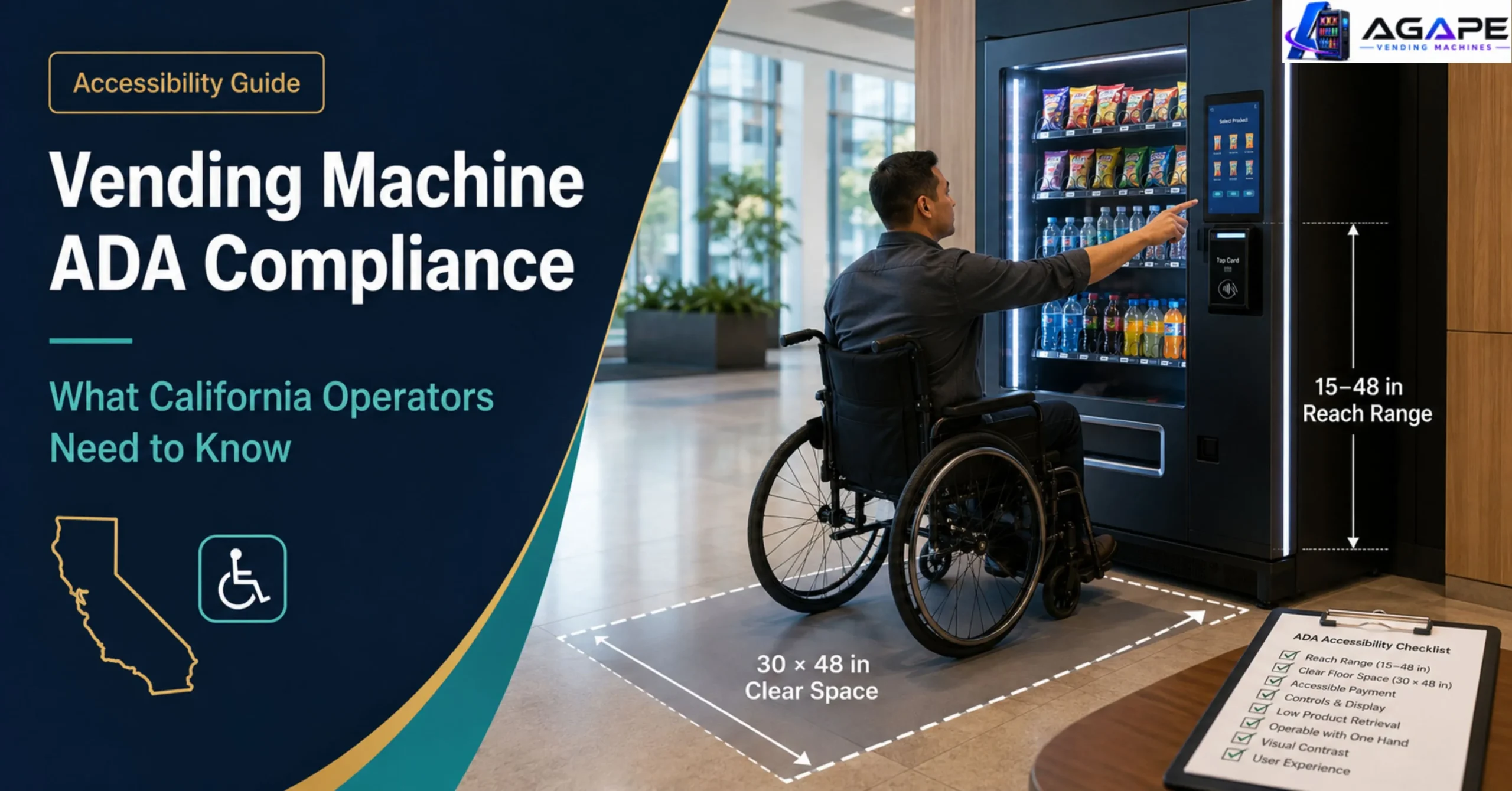
Reach Range
Controls and other operable parts required to be accessible should be positioned within the applicable ADA reach ranges.
For an unobstructed forward or side reach, the typical accessible range is:
- 15 inches minimum above the finished floor
- 48 inches maximum above the finished floor
Relevant operable components may include:
- Product-selection buttons
- Touchscreen controls
- Coin slots
- Bill acceptors
- Card readers
- Keypads
- Receipt dispensers
- Product-retrieval mechanisms
However, 15 to 48 inches should not be treated as an unconditional rule for every component and configuration. The allowable reach may be affected by counters, machine projections, shelves, or other obstructions between the customer and the control.
Operators should evaluate the direction of approach and whether the customer must reach over or around an obstruction.
Clear Floor Space
A clear floor or ground space should be provided at the accessible vending machine.
The standard minimum clear space is generally:
- 30 inches wide
- 48 inches long
The space may be positioned for a forward or parallel approach, depending on the machine design and surrounding area.
Providing enough open floor space allows a wheelchair or other mobility device to approach the machine. However, the space must remain clear after installation.
Common obstructions include:
- Trash cans
- Recycling bins
- Mop buckets
- Wet-floor signs
- Chairs
- Tables
- Product boxes
- Cleaning supplies
- Promotional displays
Clear floor space is not merely an installation requirement. It must be maintained during the daily operation of the facility.
Accessible Route
The route from an accessible entrance to the vending machine should remain accessible and unobstructed.
When evaluating the route, check for:
- Stairs without an accessible alternative
- Narrow hallways
- Heavy or difficult-to-operate doors
- Furniture blocking the route
- Machines projecting into circulation paths
- Boxes or supplies stored in walkways
- Abrupt level changes
- Inadequate turning or maneuvering space
A machine with accessible controls does not solve the problem if a customer cannot reach the vending area.
Operable Parts
Operable parts required to be accessible should be usable with one hand. They should not require tight grasping, pinching, or twisting of the wrist.
The force required to activate an operable part is generally limited to five pounds.
Operators can perform a basic usability check by attempting to complete a purchase using one hand. This is not a substitute for a professional inspection, but it can help identify stiff buttons, difficult retrieval doors, and payment mechanisms that require excessive force.
When Vending Machines Get Smart, Accessibility Gets Complicated
Modern vending technology has introduced accessibility concerns that were less common when the 2010 ADA Standards were developed.
Newer machines may use:
- Touchscreen interfaces
- QR-code ordering
- Mobile applications
- App-based door unlocking
- Cashless-only payment
- Digital product labels
- Facial or object-recognition technology
- AI-powered checkout systems
- Smart coolers and unattended micromarkets
A flat touchscreen may provide no tactile method for a blind customer to identify products or controls. A customer with limited hand mobility may struggle with a small QR code, complicated touchscreen gestures, or an application that requires precise tapping.
A cashless payment terminal may also create difficulties if it does not provide accessible instructions, identifiable controls, sufficient visual contrast, or appropriate feedback.
Existing federal accessibility standards do not explain every requirement for every modern vending interface. Nevertheless, businesses must still consider their broader responsibility to provide people with disabilities equal access to the products and services they offer.
When evaluating a smart vending system, consider whether customers can:
- Identify available products
- Understand product prices
- Navigate the interface
- Select a product
- Use the payment terminal
- Enter required information
- Confirm the transaction
- Cancel an incorrect transaction
- Receive status or error information
- Retrieve the purchased product
When no employee is available to assist, the accessibility of the technology becomes especially important.
California’s Additional Accessibility Requirements
California businesses must consider both federal ADA requirements and California accessibility laws.
The Unruh Civil Rights Act generally requires businesses to provide full and equal accommodations, advantages, facilities, privileges, and services. Certain ADA violations may also constitute violations of the Unruh Act.
Federal ADA Title III cases commonly focus on correcting accessibility barriers and may involve injunctive relief and attorneys’ fees. California law may allow monetary damages in qualifying cases.
Because the interaction between federal standards, California building requirements, and state civil-rights laws can be complicated, operators should avoid relying solely on a manufacturer’s ADA-compliant” label.
Compliance must be evaluated in the context of the actual facility and installation.
Understanding the ADA Safe Harbor
The ADA safe-harbor provision may apply to certain existing elements that complied with the 1991 ADA Standards and were not altered after March 15, 2012.
An eligible element may not have to be modified solely to meet a corresponding requirement introduced or changed under the 2010 Standards.
However, safe harbor is not a blanket exemption for an entire property or every old vending-machine installation.
Its application depends on:
- The specific element being evaluated
- Whether the element complied with the 1991 Standards
- Whether corresponding requirements existed under the earlier standards
- Whether the element has subsequently been altered
- The nature and extent of any new work
- Which standards apply to the facility
Newly installed or altered fixed elements generally need to comply with the standards applicable when the installation or alteration occurs.
Operators should obtain professional guidance before assuming that an older machine or vending area is protected by safe harbor.
How a CASp Inspection Can Help
California’s Certified Access Specialist program provides trained professionals who can inspect buildings and sites for compliance with applicable accessibility standards.
A CASp inspection may help a business:
- Identify accessibility barriers
- Understand which standards apply
- Develop a schedule for correcting problems
- Document its accessibility efforts
- Reduce uncertainty before renovating a facility
- Obtain certain procedural or legal benefits under California law
However, a CASp inspection does not guarantee that a business cannot be sued or found liable.
The potential benefits depend on the inspection, the resulting report, the business’s compliance status, and whether identified corrections are completed within the applicable period.
A CASp inspection may be particularly valuable for:
- Hospitals
- Educational facilities
- Government-adjacent properties
- Shopping centers
- Transportation facilities
- Large workplaces
- High-traffic public locations
- Properties with multiple vending areas
What Vending Machine Non-Compliance Can Cost
Accessibility problems can become expensive even when the physical correction itself is relatively simple.
Potential costs may include:
- Accessibility inspections
- Equipment replacement
- Installation work
- Corrective construction
- Attorneys’ fees
- Settlement costs
- Business interruptions
- Staff time
- Reputational damage
- Monetary exposure under applicable California law
In enforcement actions brought by the U.S. Department of Justice, courts may also impose civil penalties for Title III violations. Maximum federal penalty amounts are periodically adjusted for inflation, so businesses should verify the current amounts through official DOJ guidance.
A private ADA complaint does not automatically result in a federal civil penalty for every barrier. The available remedies and potential costs depend on who brings the case, the law involved, and the facts of the claim.
California has a high volume of disability-access litigation. Clearly measurable barriers, such as inaccessible controls, insufficient clear floor space, or an obstructed accessible route, can increase the risk of a complaint.
Fortunately, many vending-machine accessibility problems may be easier to correct than major structural barriers.
Depending on the issue, a remedy might involve:
- Repositioning the machine
- Removing an obstruction
- Improving the approach route
- Replacing the payment terminal
- Adjusting the interface
- Adding appropriate accessibility features
- Selecting a more accessible machine
The cost will depend on the machine, technology, installation, and surrounding facility.
A Practical Vending Machine Accessibility Checklist for California Operators
Use the following checklist to conduct an initial review of your vending locations.
1. Measure the Reach Range
Check the product-selection controls, coin slot, bill acceptor, card reader, keypad, and other required operable parts.
For an unobstructed reach, the typical accessible range is 15 to 48 inches above the finished floor. If an obstruction exists, additional reach limitations may apply.
2. Measure the Clear Floor Space
Confirm that a clear space measuring at least 30 by 48 inches is available at the machine.
Determine whether the space provides the required forward or parallel approach.
3. Test One-Handed Operation
Attempt to select and purchase a product using one hand.
Check whether any part requires:
- Tight grasping
- Pinching
- Wrist twisting
- Excessive force
- Complicated simultaneous movements
4. Evaluate Nonvisual Usability
Determine whether a customer who cannot see the screen or product display can independently:
- Identify products
- Understand prices
- Select an item
- Complete payment
- Receive confirmation
- Retrieve the product
Do not assume that Braille, audio instructions, or a particular feature is legally required for every vending machine. Evaluate the complete customer experience and the requirements applicable to the specific system.
5. Walk the Accessible Route
Start at the accessible entrance and travel to the vending machine.
Look for stairs, narrow passages, difficult doors, level changes, stored materials, furniture, or other barriers.
6. Audit the Digital Experience
For touchscreen or app-based machines, evaluate:
- Screen-reader compatibility
- Color contrast
- Text size
- Touch-target size
- Interface timing
- Error messages
- Alternative input methods
- Accessible payment options
- Nonvisual transaction feedback
7. Review Every Type of Machine
If the location provides snack, beverage, coffee, frozen-food, or other vending-machine types, evaluate each category.
The number of machines required to meet specific technical standards may depend on the facility and applicable codes. Do not assume that one universal rule applies to every property.
8. Keep the Area Clear
Make sure trash cans, signs, boxes, furniture, and cleaning supplies do not block the machine or accessible route.
Include the vending area in regular housekeeping inspections.
9. Document the Review
Record:
- Measurements
- Machine model
- Installation method
- Photographs
- Inspection date
- Identified barriers
- Corrective actions
- Completion dates
Documentation can demonstrate that the business is actively evaluating and addressing accessibility.
10. Consider a CASp Inspection
For high-traffic or higher-risk California locations, consider hiring a Certified Access Specialist to evaluate the vending area and surrounding facility.
11. Schedule Recurring Checks
Accessibility is not a one-time installation task.
Machines are replaced, furniture moves, payment terminals change, and floor space becomes blocked. Conduct recurring inspections and review the location whenever equipment is installed, moved, or upgraded.
The Bigger Picture: Accessibility Is Good Business
More than one in four adults in the United States has some type of disability. People with disabilities are not a small or unusual customer group. They represent a significant portion of the population and consumer market.
Accessible vending design can also improve usability for many other customers.
For example:
- Larger controls help people carrying bags or using a phone.
- Clear instructions help first-time customers.
- Better contrast improves visibility in poor lighting.
- Audio and visual feedback help customers confirm transactions.
- Clear floor space makes the vending area easier for everyone to use.
- Simple payment systems reduce abandoned purchases.
Accessibility should not be viewed only as a legal expense. It can improve customer experience, reduce barriers, and allow more people to purchase products independently.
The goal is not merely to place a compliance certificate on the wall. The goal is to ensure that an ordinary activity, such as purchasing a drink or snack, does not require a person with a disability to find and depend on someone else.
Frequently Asked Questions About Vending Machine ADA Compliance
Not every machine is necessarily governed by identical technical requirements. The answer depends on whether the machine is fixed or movable, where it is located, how the facility is used, and which federal and California requirements apply.
However, the facility must still consider whether people with disabilities have equal access to the goods and services offered.
For an unobstructed forward or side reach, required operable parts are generally positioned between 15 and 48 inches above the finished floor.
Obstructed reaches may be subject to additional limitations.
A clear floor or ground space measuring at least 30 by 48 inches should generally be provided and positioned for the required forward or parallel approach.
No. A touchscreen does not automatically make a machine accessible or inaccessible.
Accessibility depends on whether customers with visual, hearing, mobility, cognitive, and other disabilities can identify products, operate the interface, complete payment, receive necessary feedback, and retrieve their purchase.
Potential consequences may include corrective work, accessibility complaints, private lawsuits, attorneys’ fees, settlements, and California statutory-damages claims in qualifying cases.
Civil penalties may also be available in certain enforcement actions brought by the U.S. Department of Justice.
Final Thoughts
Vending machine accessibility involves more than measuring the height of a coin slot. Operators must consider the entire purchasing journey, from entering the building and reaching the machine to selecting, paying for, and retrieving a product.
The applicable requirements can vary based on the machine, installation, facility, construction history, and relevant federal and California codes.
The safest approach is to evaluate accessibility before installing a machine, document the review, maintain the surrounding area, and consult a qualified accessibility professional when requirements are unclear.
Disclaimer: This article provides general information and does not constitute legal advice. Accessibility requirements vary depending on the facility, machine configuration, installation date, and applicable federal, California, and local codes. Consult a qualified accessibility professional, Certified Access Specialist, or attorney for guidance specific to your location.